Return policy template for online stores, with refund, exchange and shipping policies

Muhammad Hassan, FounderLinkedIn
Published Updated
A return policy template is a ready-written return and refund policy that an online store copies, fills in and publishes. It tells customers how many days they have to send an item back, what condition it must be in, who pays the return postage, and how and when they get their money back.
We make HiQBot, a customer service platform with AI agents, live chat, guided flows and WhatsApp calling, and its AI agent answers return questions from the policy a store gives it. Below are four templates to copy (a return policy, a refund policy, an exchange policy and a shipping policy), clauses for eight kinds of store, and the consumer law to check before you publish.
What is a return policy?
A return policy is the set of rules a store publishes for sending items back: the time limit, the condition, the exceptions and the refund. A refund policy covers the money side of the same promise, an exchange policy covers swaps, and a shipping policy covers delivery. Small stores often put all four on one page called “Returns and refunds” and link the shipping policy beside it.
Customers read it before they buy, especially for clothes and shoes they can’t try on, and again when something doesn’t fit. Many skip the page and ask in the chat instead: “Can I return this?”
What a return policy should cover
| Part | What it says |
|---|---|
| Return window | How many days, counted from delivery |
| Condition | Unused, tags on, original packaging |
| Exceptions | What can’t come back, such as personalised or opened hygiene items |
| How to start | Where to message, and what to include |
| Return shipping | Who pays, and whether you send a label |
| Refunds | To which payment method, and how many days |
| Exchanges | Size and colour swaps, and the price difference |
| Faulty or wrong items | What you do, and that you pay the return |
Return policy template for an online store
Copy it into a page on your store, change every [bracketed] word, and add the clauses for your kind of store from further down. It is written for a small store that sells physical products and ships them.
Refund policy template
Use this when you want a separate refund policy page, or paste its sections under “Refunds” in the template above. It answers the questions customers ask after they send something back: how much, to where, and when.
Exchange policy template
For stores where most returns are a wrong size, an exchange policy keeps the sale. This one has you confirm stock before the customer posts anything, so nobody waits for a size that has sold out.
Shipping policy template for a small business
A shipping policy answers the other half of after-sale questions: when the order leaves, how long it takes, what it costs, and what happens if it goes missing. Many stores publish it beside the return policy, as one shipping and return policy.
Return policy clauses by store type
Add the clause for your kind of store to the return policy template, under “Items we can’t take back” or as its own section.
Clothing and shoes
Beauty and skincare
Electronics and gadgets
Furniture and large items
Made-to-order and personalised items
Food, flowers and other perishables
Dropshipping stores
Cash on delivery stores
How to write a good return policy
- Pick the window. Count it from delivery. 30 days gives customers time to try things at home. 14 days is the legal minimum to cancel in the EU and UK, so don’t go shorter there.
- List the exceptions. Personalised, perishable and opened hygiene items are the usual ones. Faulty or wrong items are never an exception.
- Decide who pays the return postage. Free returns cost you the postage on every return. Whichever you choose, say it before the customer buys.
- Promise a refund time you can keep. Count from the day the parcel reaches you.
- Say how to start a return. One message with the order number, on the channel the customer already uses.
- Write it in plain words. “You can return most items within 30 days” beats “Merchandise may be returned subject to the conditions herein.”
- Check your local law (next section), then publish it in the footer, on product pages, at checkout and in the order confirmation email.
What the law requires
Your policy can be more generous than the law. These are the minimums where most of our readers sell:
European Union
Customers who buy online can cancel within 14 days without giving a reason, counted from the day the goods are delivered. They pay the return postage unless you offered to, or didn’t tell them the cost before they bought, and you pay to return a defective item. Made-to-order or personalised goods, perishable goods and unsealed audio, video or software are exempt (Your Europe, European Union).
United Kingdom
Online customers have 14 days after receiving an item to tell you they want to cancel, then another 14 days to send it back. You refund within 14 days of getting it back, including standard delivery if they paid for it (GOV.UK, distance selling). A faulty item, or one not as described, gets a full refund (GOV.UK, accepting returns), and the Consumer Rights Act 2015 gives customers 30 days to reject it (section 22).
India
Under the Consumer Protection (E-Commerce) Rules, 2020, online sellers must show their return, refund, exchange, warranty, delivery and shipment terms, including the cost of return shipping. They can’t refuse to take back goods that are defective, deficient, spurious or not as advertised, or refuse the refund (Gazette of India, 23 July 2020).
United States
The FTC’s Mail, Internet or Telephone Order Rule covers shipping, not returns. You ship within the time you state, or within 30 days if you state none. When you can’t, you let the customer agree to the delay or cancel, and refund a cancelled order within seven working days, or within one billing cycle for credit card orders (FTC). Whether you take back items that aren’t faulty is up to your policy and your state’s law.
United Arab Emirates
The consumer protection law, Federal Law No. 15 of 2020 as amended by Federal Decree-Law No. 5 of 2023, requires suppliers to repair or replace a defective product free of charge, and online sellers to disclose their contract, payment and warranty terms (u.ae). It covers stores registered in the UAE, not online sellers registered abroad.
Selling anywhere else, check your national consumer authority before you publish.
What happens when a return request comes in
A customer writes “it’s too big, can I swap it?” on WhatsApp at 11 pm, and someone has to read the policy, check the order and decide. That is most of returns management for a small store, and a written policy already answers most of those questions.
In HiQBot, the AI agent answers from your policy:
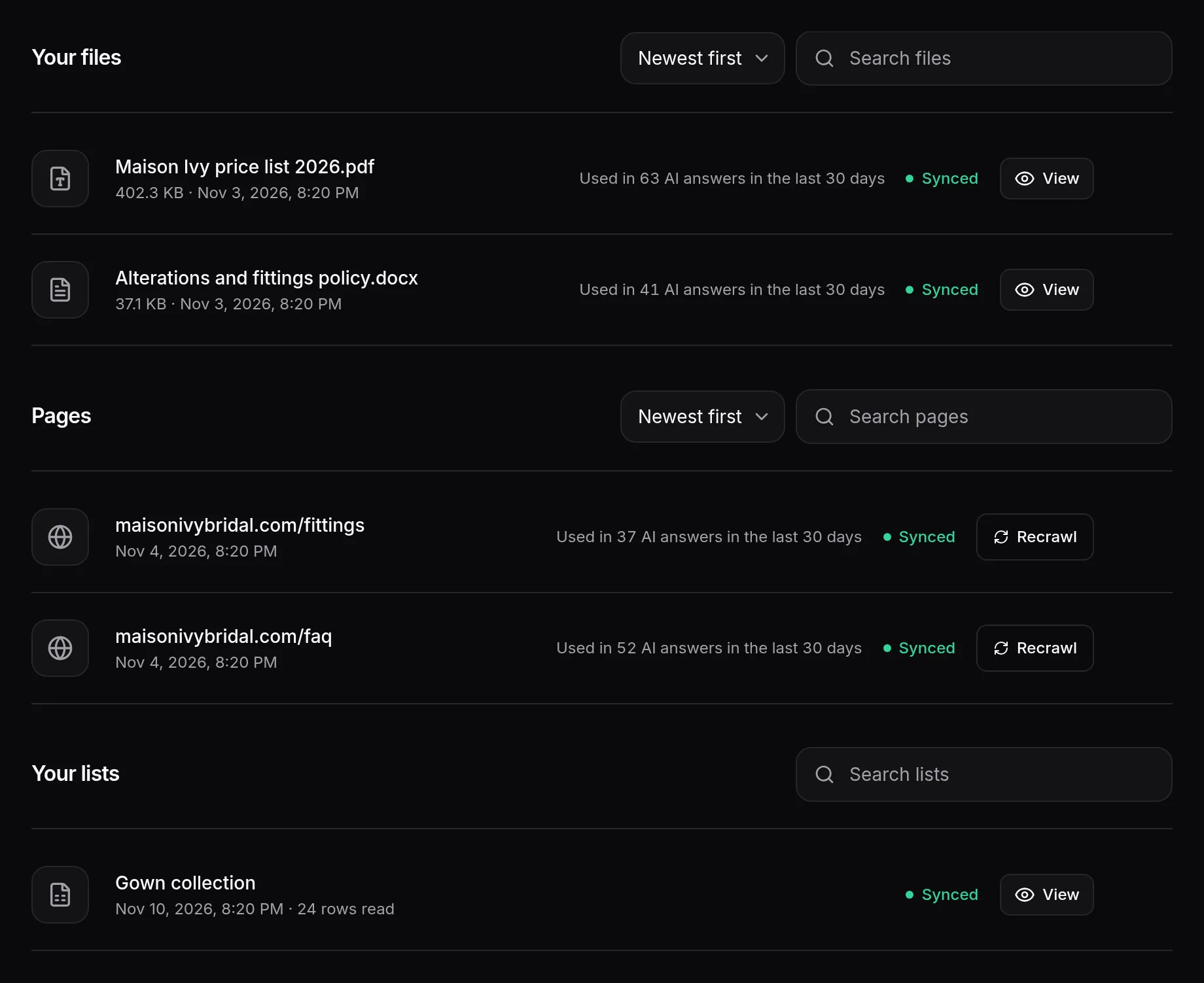
- Add the policy to the knowledge base. Upload it as a file or add the page from your website. The AI agent answers from it on website chat, WhatsApp, Instagram, Messenger, Telegram and LINE.
- Shoppers get answers at any hour. “Can I return a sale item?” or “How long do refunds take?” is answered from your terms. Customers can send a photo of the damage or the wrong item, and the AI reads it.
- Requests go to your team. With a WooCommerce store connected, the AI files a refund, exchange, cancellation or address-change request with the customer’s reason and its check against your policy. It lands in Orders under Needs you, where a person approves or declines it and carries it out in WooCommerce. HiQBot changes nothing on the order, and the customer can withdraw the request in the same chat while it waits.
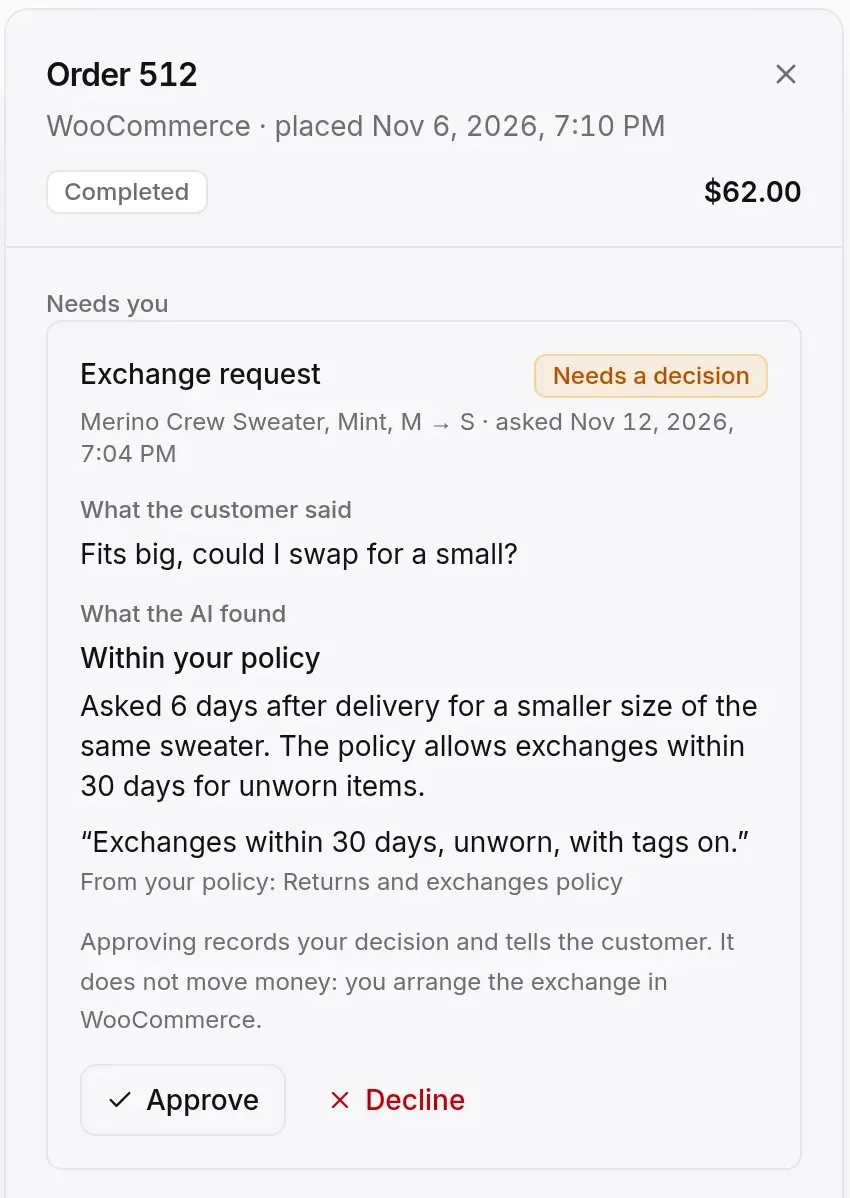
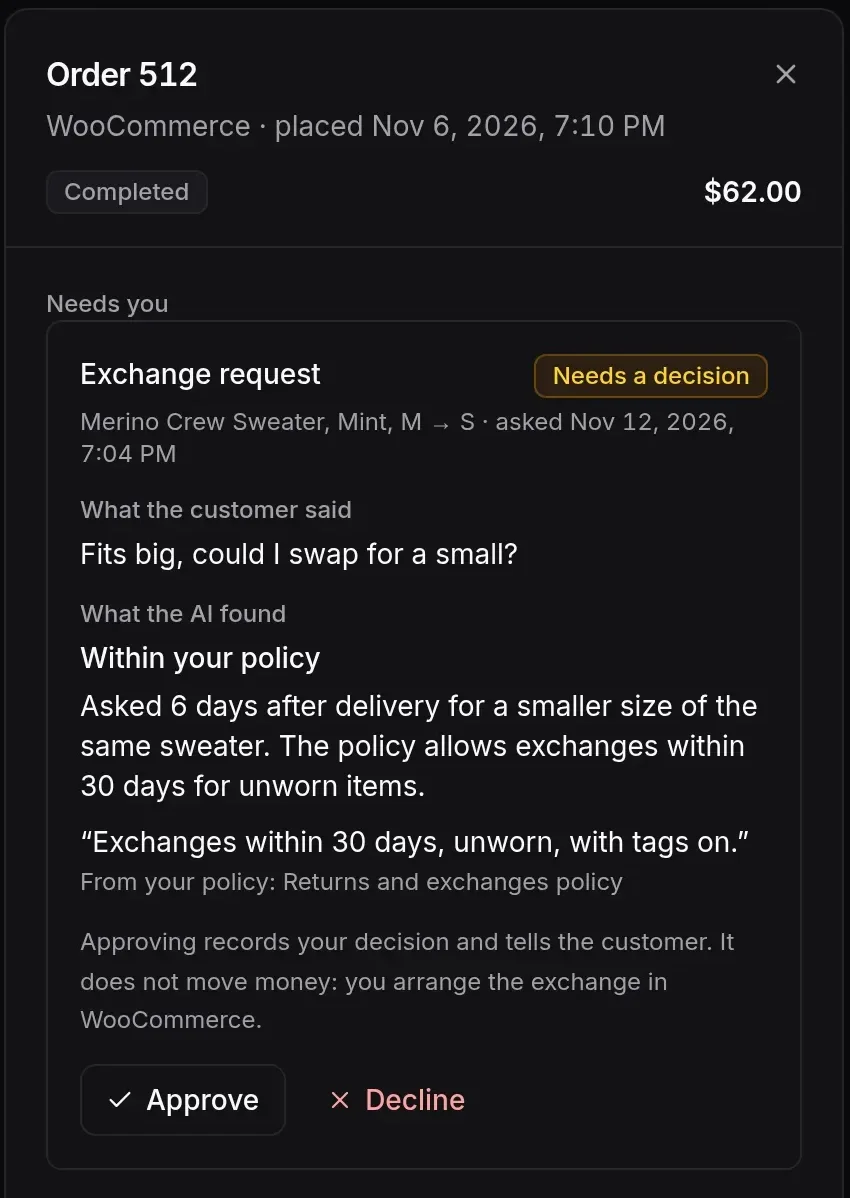
With WooCommerce connected, the AI also looks up an order once the customer gives the order number and the email or phone used at checkout, so a customer asking about a refund sees whether the order shows as refunded. A question your policy doesn’t cover shows up in your knowledge gaps, and the answer you type there goes into the knowledge base for next time.
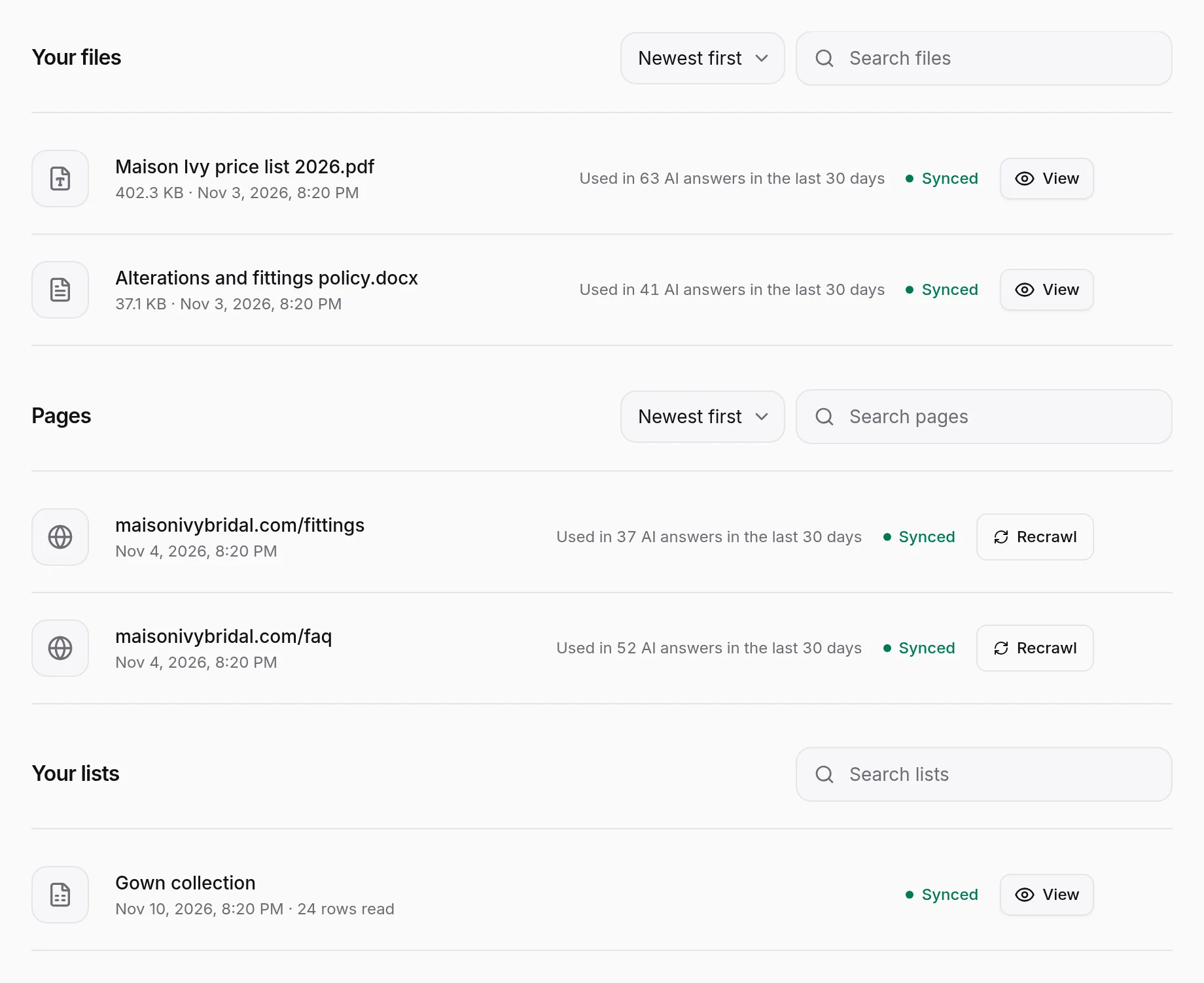
The rest of the after-sale work is on our AI chatbot for ecommerce page, the store connection on our WooCommerce chatbot page, and the other questions shoppers ask in our ecommerce customer service guide.
Common questions
How do I write a good return policy?
State the return window, the condition items must be in, what can’t be returned, who pays return postage, and how and when refunds are paid. Use plain words, check your local consumer law, and publish it where customers look before and after they buy.
Can you give an example of a return policy?
“You can return most items within 30 days of delivery, unused and with tags attached. Message us with your order number to start a return. Refunds go to your original payment method within 14 days of the item reaching us.” The full template is above.
How can I generate a return policy?
Copy the template on this page and fill in the brackets: your window, exceptions, return shipping, refund time and contact details. Policy generators ask the same questions and produce similar text.
What is the difference between a return policy and a refund policy?
A return policy says when and how items can come back. A refund policy says how the money goes back: to which payment method, how fast, and what isn’t refunded. Many stores publish both on one page.
Do I have to accept returns?
In the EU and UK, yes for most goods: online customers can cancel within 14 days of delivery, with exceptions such as personalised or perishable items. In the US, federal mail order rules cover shipping, not returns, so your policy and your state’s law decide.
Should my return policy be 14 or 30 days?
Either works outside the EU and UK, and 30 days gives customers time to try things at home. In the EU and UK, 14 days after delivery is the legal minimum to cancel, so a shorter window breaks the law there.
Can the AI refund a customer by itself?
No. HiQBot’s AI agent answers from your policy. With WooCommerce connected, it files the request with its check against the policy, and a person approves it and makes the refund in your store.
The consumer law sources were read on . This post is general information, not legal advice. The screens are the real HiQBot product with sample data. To report an error, see our editorial standards.