Automotive chatbot for car dealerships: test drives, service bookings and repairs in chat
It answers buyers and service customers on website chat, WhatsApp, Instagram, Messenger, Telegram and LINE, books the test drive or the workshop slot, and gets problems with your own work to a person.
7-day free trial. Test drives, service bookings and repair tickets included.
What is an automotive chatbot?
An automotive chatbot is AI software that answers people buying a car or getting one serviced, in writing.
It works out which one is happening before it asks anything else. A buyer gets questions about the kind of vehicle, a rough budget and when they can come in; someone reporting a fault gets asked about the vehicle and the problem instead. Behind both sit two departments. Sales enquiries turn into test drives, stock requests or a callback from your team. Service enquiries turn into workshop bookings, and a repair that did not hold turns into a support request rather than a fresh sale. A dealership chatbot built for one side usually gets the other half wrong, so HiQBot comes tuned for both, and answers on website chat, WhatsApp, Instagram, Messenger, Telegram and LINE.
HiQBot is a conversational platform for customer service, with AI agents and live chat on website chat, WhatsApp, Instagram, Messenger, Telegram and LINE.
What it does for a dealership
A car dealership chatbot has to split its attention the way the showroom floor does. HiQBot runs the sales side and the service side from the same inbox, with its own set of outcomes for each, and your team can step in with live chat for car dealerships whenever a person should answer.
Sales
- Answer stock and model questions from your own lists
- Book test drives at times you actually have free
- Take a stock request when the exact vehicle is not listed
- Note the trade-in and rough budget for your sales team
- Request a callback for finance specifics
- Add your own questions, like buying timeline
Service
- Read a symptom as a job to book, not just a complaint
- Check the job is one you actually do, first
- Flag brakes, steering, smoke or a car that will not start as urgent
- Book the slot with the vehicle and the symptom in the notes
- Open a support ticket when a repair comes back
- Answer warranty and recall questions from what you've uploaded
The agent can also open a support ticket, hand a conversation to a person live, and move or cancel a booking when the customer asks.
Sales
Dealership lead generation, answered in chat
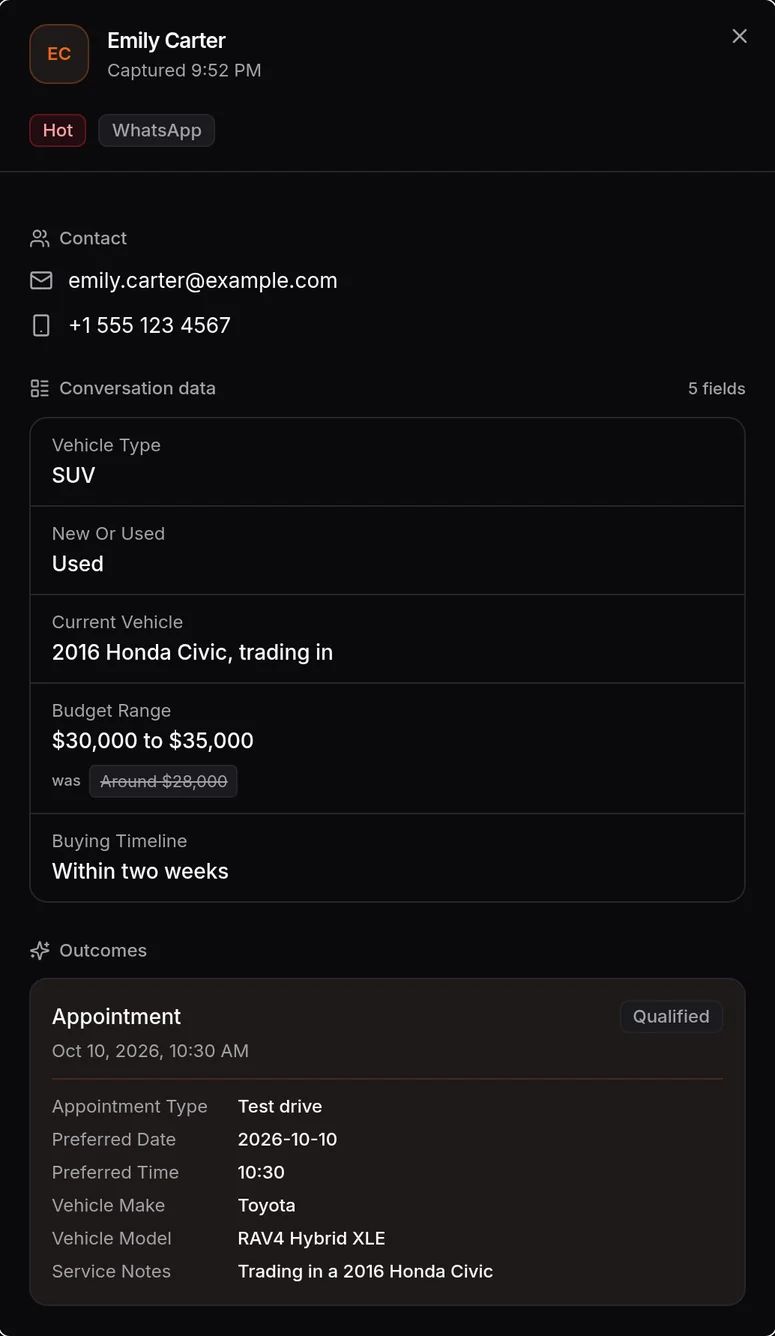
Someone writes in asking about a specific car, a body style, or just “anything under thirty thousand with low mileage.” HiQBot answers from the stock lists and pages you have given it, so a 2023 RAV4 Hybrid with 18,400 miles comes back as exactly that, not a guess. It never invents a price or says something is in stock when it is not. When what they want is not listed, it takes a stock request with the vehicle they are after and their email, so your team can reply once something comes in.
Once a buyer is interested, the agent checks your booking hours and offers only the times that are actually free. The buyer picks a time, gives a name and a phone number, and the booking is confirmed in the chat, with the vehicle and any notes attached.
It also asks what they are driving now and roughly what they want to spend, because that is useful context for whoever calls them back. It does not put a number on the trade-in; valuing a car stays a job for a person who can actually look at it. General finance questions get answered from whatever information you have given it, and specifics like a rate or a pre-approval go to a callback request instead. Buying timeline, part-exchange mileage, whether they want finance arranged: none of these are built in, but you can add them as your own questions, so the lead that lands on a salesperson’s desk has whatever your floor actually asks for.
How lead qualification works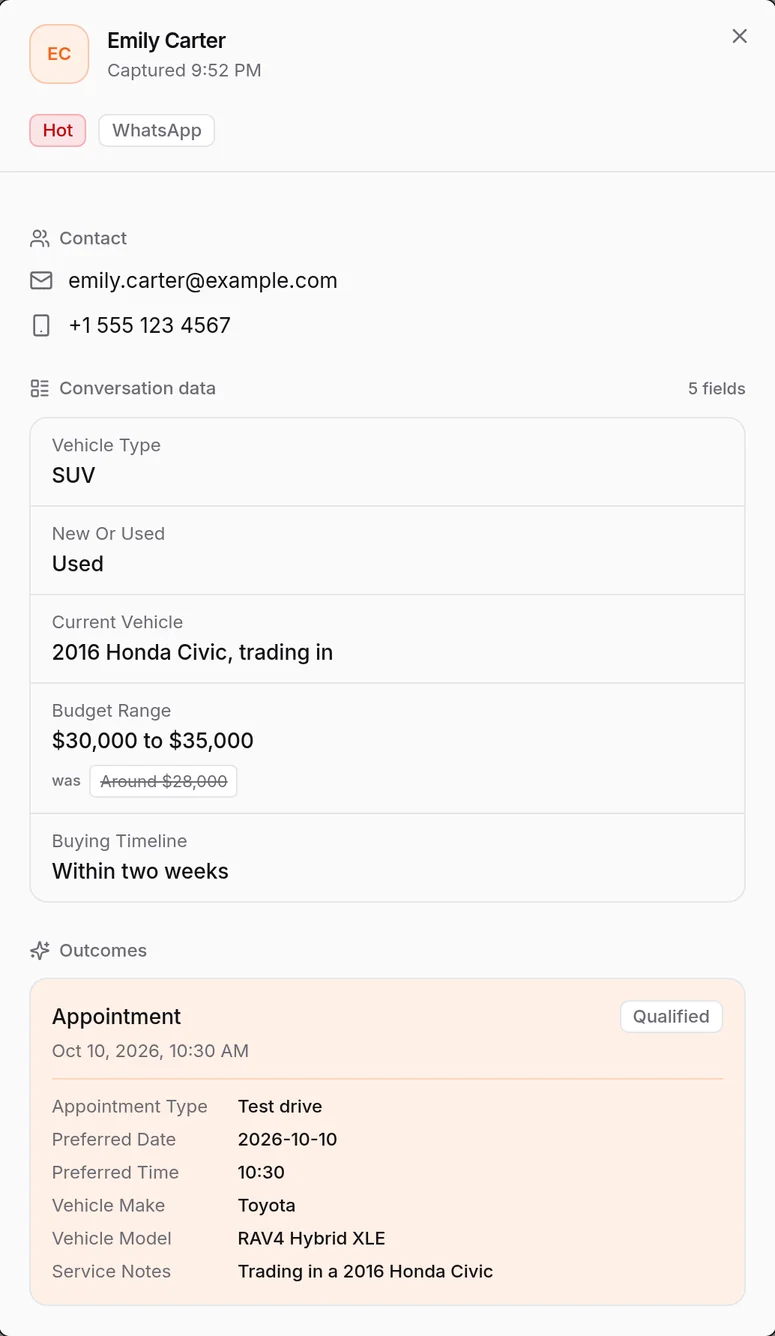
Service
Service bookings and auto repair questions, from symptom to slot
A grinding noise, a warning light, a smell that was not there last week: most service enquiries arrive as a description, not a request. HiQBot reads that description as work worth booking, in writing, the same way a service advisor would over the phone.
Before it asks for a single detail, it checks the description against your profile and whatever you have uploaded. A workshop that only does tyres and exhausts should not end up taking details for a transmission rebuild. If the job is not one you cover, it says plainly that it cannot confirm that and offers to get the customer to someone who can.
Treated as urgent
Brakes, steering, smoke, or a car that will not start. When a symptom touches any of those, the agent says clearly if the car should not be driven to the appointment, rather than booking it in for whenever is convenient and leaving that call to the front desk.
The booking your workshop receives has the date, the time, the vehicle’s make, model and year, and the symptom written into the notes, so whoever opens the bay that morning already knows what they are looking at. If you have set a capacity, such as how many cars can be worked on at once, the agent only offers slots that fit inside it. For a workshop without its own automotive booking system, that is enough to take service bookings around the clock.
Comebacks
Warranty, recalls and repairs that come back
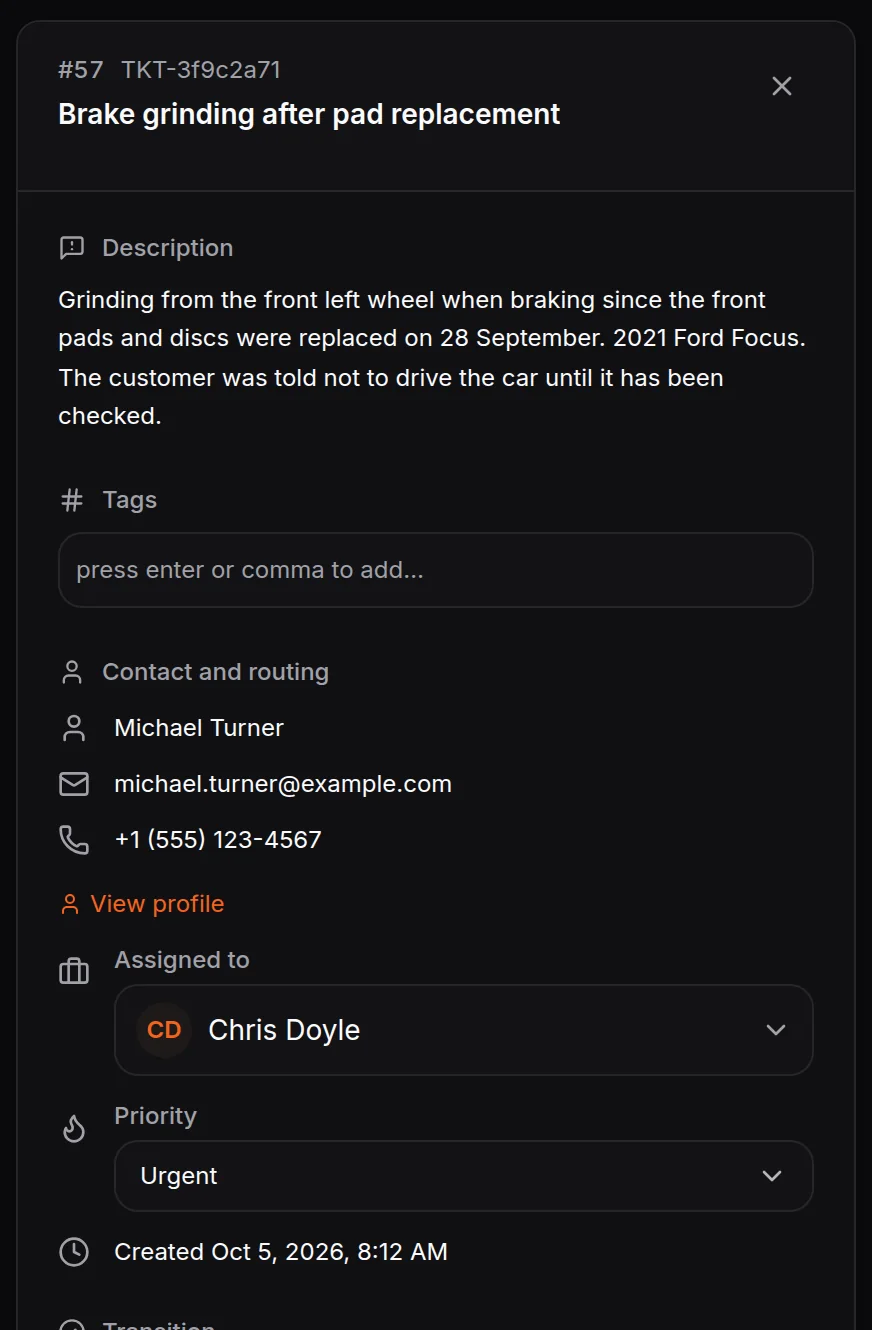
When the same fault shows up again on work your own shop carried out, the agent does not try to sell a second visit. It opens a support ticket with the fault, when it started and the vehicle, marks it urgent for anything touching brakes, steering or airbags, and tells the driver plainly if the car should not be driven. It never offers a refund or a free repair on its own; that decision stays with a person.
A warranty dispute or a question about an invoice gets raised for a person too, with the detail already written up, and the agent does not argue the case or blame the customer for a comeback. Ask it about a recall and it answers from the recall notices you have uploaded, then books the recall work like any other appointment; it does not look anything up in a manufacturer database or run a VIN check. A customer with a ticket number can ask where things stand, and the agent reads it back to them without needing to repeat the whole story.
How AI helpdesk tickets work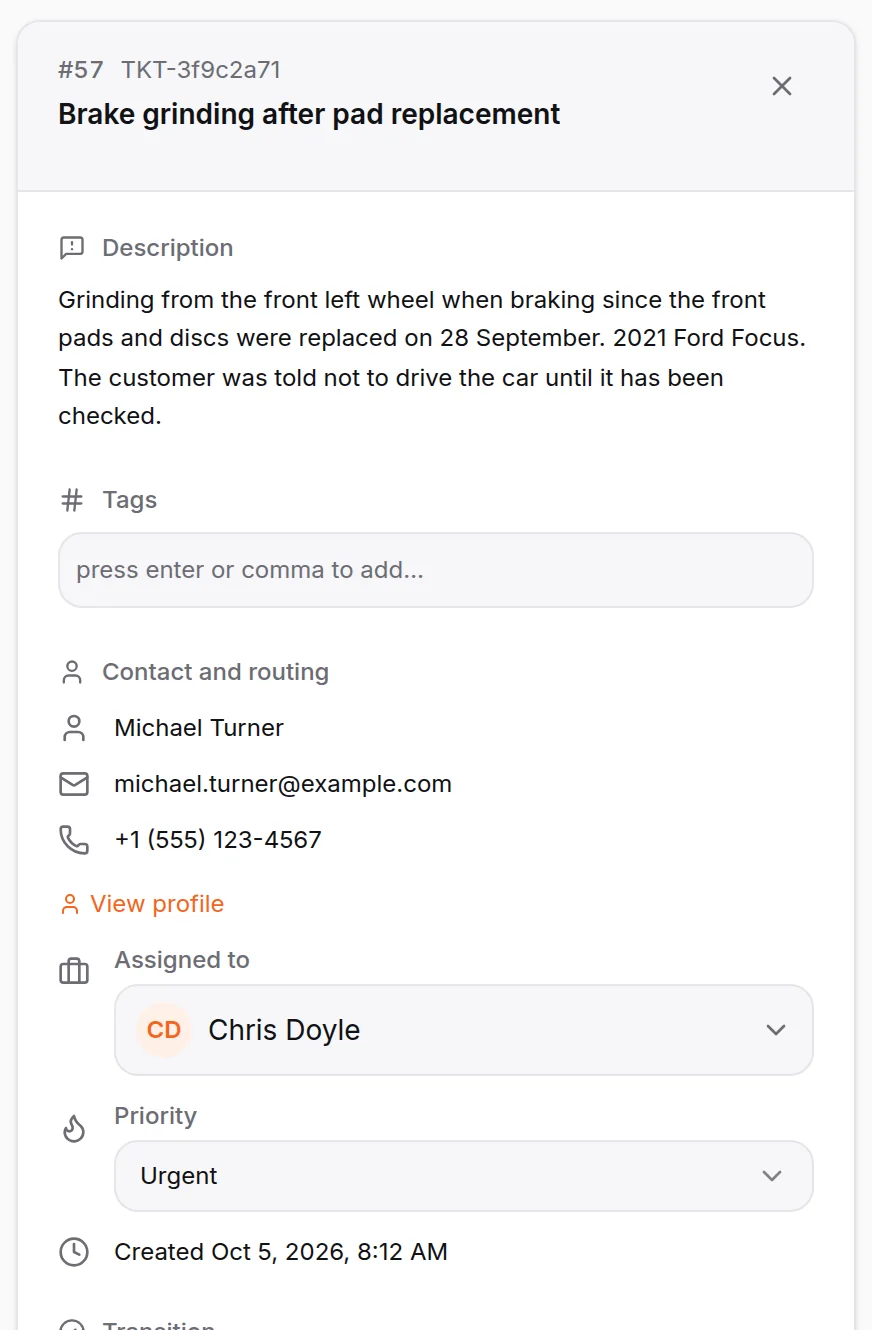
People
When a customer needs a person
Some conversations need a person straight away, a comeback on your own work, a customer who is upset, a question nothing you have uploaded covers. The agent brings in your team in the same thread, and whoever picks it up sees everything said so far, ticket number included.
How live chat and tickets workWhatsApp for car dealers, and the other five channels
A buyer who messages your WhatsApp Business number at nine in the evening and a shopper who opens your website chat at lunch reach the same agent, with the same stock lists and the same booking hours behind both. WhatsApp broadcasts let your team send approved updates, a recall notice or a service reminder, to contacts who have opted in; the agent itself does not start those on its own.
- Website chatThe chat widget on your dealership site
- WhatsAppYour WhatsApp Business number
- InstagramDMs, including ones that start from a comment on a car post
- MessengerMessages to your dealership's Facebook Page
- TelegramMessages to your Telegram bot
- LINEYour LINE Official Account
On Instagram, a comment on a car post can start the whole thing. Someone comments “is this one still available” under a photo of a vehicle, gets a reply telling them to check their DMs, and the agent carries on from there, asking for a name and a number to book the test drive. See how comment to DM works.
After hours, and across more than one location
A buyer messaging about the RAV4 Hybrid at a quarter to ten in the evening gets the same answer she would get at nine the next morning. HiQBot does not close with the showroom. What it cannot do is promise someone is about to call back right this second outside your working hours. A booking made overnight, a stock request or a callback request waits exactly where your team left it, ready when the first person clocks in.
The hero conversation above happened at 9:47 PM. Nobody on the sales floor was online to send it.
Several showrooms and service centres
A group running more than one location gives each branch, or each department within a branch, its own inbox: its own WhatsApp number and other channels, its own hours and timezone, its own booking settings and its own version of the agent. Sales and service at the same site can run as two separate inboxes if that is how the floor actually works. A conversation that needs a person is assigned to whoever is on shift and free. Every lead and booking from every location still lands in one dashboard.
Where leads and bookings go
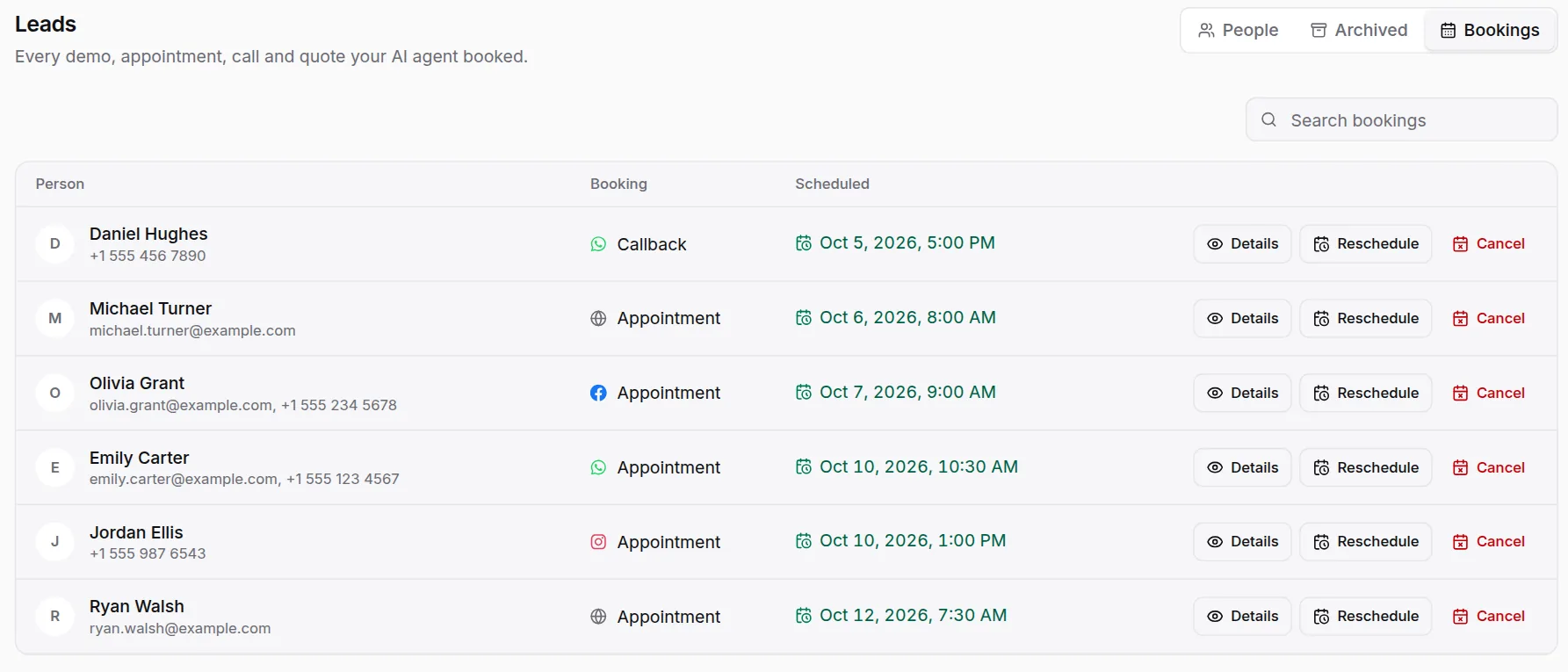
Every conversation the agent has lands as a lead in your HiQBot dashboard, marked cold, warm or hot depending on how it went. Bookings show up in your Bookings list with who it is for and when, and your team can reschedule or cancel any of them with one click. Connect Google Calendar and a test drive or a service slot mirrors onto it the moment it is booked, though a reschedule or a cancellation made afterward does not update the calendar entry itself. Connect HubSpot and the same contact and deal land there too, as the only CRM HiQBot writes to directly.
How to set it up
- 1
Choose Automotive & Dealership
Pick it when you set up your agent, so the questions and the booking fields it starts with fit a dealership rather than a generic business.
- 2
Add your stock, service menu and policies
Upload your stock list, service menu, price list, finance information and any warranty or recall notices, or point it at the pages on your site that already cover them.
- 3
Set your booking hours and capacity
Opening times, how long a slot runs, and how many can happen at once, whether that is bays in the workshop or demo cars on the lot.
- 4
Connect your channels
Website chat, WhatsApp, Instagram, Messenger, Telegram and LINE, or just the ones your customers actually use.
- 5
Decide what it asks and who picks up what
Choose the details it needs before handing someone to your team, and who on your side handles sales versus service.
What it will not do
How to choose a dealership chatbot
Most automotive chatbots look alike in a demo. These questions separate them, and they are worth asking any vendor, us included. HiQBot’s answers sit beside each one. For a longer answer on calls specifically, see how a chat agent compares to a phone receptionist.
Does it answer from your own stock and service information, or guess?
HiQBot reads your stock lists, service menu and policies, and says so when something is not in there rather than guessing.
Does it handle the service department, or only sales?
Both, from the same inbox, with its own logic for faults, safety and comebacks on the service side.
Does it offer only times that are actually free?
Yes. It checks your booking hours and capacity before offering a slot, and holds nothing until the customer confirms.
Does it work on every channel your customers already use?
Website chat, WhatsApp, Instagram, Messenger, Telegram and LINE, from one inbox.
Does it make phone calls?
No, it is a chat agent. Anything that needs a voice becomes a callback request for your team.
Questions from dealers and service managers
Last updated
What is an automotive chatbot?
An automotive chatbot is AI software that answers people buying a car or getting one serviced, in chat. HiQBot reads from your own stock lists, service menu and policies, works out whether someone is buying or booking a repair, then books a test drive or service visit, or passes the enquiry to your team.
Does it answer phone calls?
No. HiQBot only writes: website chat, WhatsApp, Instagram, Messenger, Telegram and LINE. It never makes or takes a call. When a customer would rather talk, it takes a callback request with a time and a topic, and someone from your team calls them back.
Can it see our live inventory?
Not from a dealer management system. It answers stock questions from the stock lists and pages you upload or connect, so keep them current. When a buyer wants options sent over, it takes down what they are after and their email, and your team replies with what is actually on the lot.
Can it book test drives and service appointments?
Yes, both in the same chat, with the date, time, vehicle and any notes attached. Set your booking hours, slot length and how many can run at once, and it only offers times that are actually free. Bookings land in your dashboard, and in Google Calendar when it is connected.
Will it value a trade-in or approve finance?
No. It asks what the buyer drives now and roughly what they want to spend, and hands that to your sales team. It can answer general finance questions from information you give it, but valuations, credit checks and approvals stay with your people.
What happens when a repair we did comes back?
It stops selling. Where support tickets are part of your setup, it opens one with the fault, when it started and the vehicle, marked urgent for anything touching brakes, steering or airbags, and tells the driver plainly if the car should not be driven. Otherwise it files a follow-up request for your team. Either way, it never offers a refund or a free repair on its own.
Can customers reschedule or cancel a booking by chat?
Yes. The AI finds the booking by the email or phone number it was made with, then moves it to a free time or cancels it. Your team can also move or cancel any booking from the dashboard in one click.
Does it work for a service-only workshop?
Yes. You describe what your business actually does, and the agent checks a job is one you handle before it asks for a single detail. Someone asking about buying a car from a service-only shop is told it cannot confirm that, with an offer to put them through to your team.
Can we run more than one showroom or service centre?
Yes. Each branch or department can have its own inbox, with its own number, hours, timezone and booking settings. Every lead and booking still lands in one dashboard, whichever location it came through.
What languages does it reply in?
Whatever language the customer writes in. A buyer who messages in Spanish or Arabic gets an answer in that language, drawn from the same stock lists and policies you uploaded, and your team reads the whole conversation in one inbox regardless of the language it is in.
Other industries we ship for
Give your sales and service teams one inbox
Connect your stock list and service menu, try it on a real vehicle question, and see the booking land in your dashboard before you pay for anything.