Real estate lead generation: where leads come from, and how to answer them before another agent does

Muhammad Hassan, FounderLinkedIn
Published Updated
Real estate lead generation is how an agent gets buyers and sellers to reach out, and how those messages turn into showings and listing appointments. Most of the effort goes into the first part. The second part decides who gets the client: in NAR's 2024 survey of recent buyers, 77% of repeat buyers interviewed only one agent.
We make HiQBot, a customer service platform with AI agents, live chat, guided flows and WhatsApp calling. This guide covers where real estate leads come from, how fast to answer them, what to ask, and how to follow up, with a worked example from HiQBot's setup for realtors. It is written for solo agents and small teams whose leads message at night and at weekends, and it leaves out ad budgets and portal lead costs, which vary by market. The advice on channels and timing holds whichever tools you use.
What real estate lead generation means
A lead is a person who has told you they might buy, sell or rent: a portal inquiry, a DM, a call, a name on an open house sign-in sheet. Lead generation brings those people to you. It only pays when a lead becomes an appointment, which means a showing for a buyer or a listing appointment for a seller. Count appointments rather than leads.
Buyer leads and seller leads
Buyer leads and seller leads need different first questions. A buyer wants to see a home. A seller wants to know what theirs is worth and who will sell it. Ask a seller a buyer's questions and the conversation stalls. Commercial real estate lead generation follows the same steps, with businesses and investors as the leads and first questions about space, use and lease terms.
How to get real estate leads: where they come from
Most agents get leads from the same handful of places. Each works better when people can message you easily and you answer quickly. A plan and ten ideas for getting your name in front of them are in our real estate marketing guide.
Real estate referrals and past clients
Referrals are still one of the biggest sources. In NAR's 2024 Profile of Home Buyers and Sellers, 40% of buyers found their agent through a friend, neighbor or relative, and 66% of sellers used an agent who was referred to them or one they had worked with before. Keep in touch with past clients. When a referral does message you, someone has vouched for you, so a slow reply costs more.
Portals and paid leads
Portal inquiries come from people looking at many listings at once. Speed matters most here, because the buyer sent the form a minute ago and is still on the listing.
Real estate leads in India
In India, much of the online lead generation in real estate runs through portals such as 99acres, MagicBricks and Housing.com. Put your WhatsApp Business number on every listing, so a buyer who would rather message reaches a number that answers at any hour. HiQBot answers those WhatsApp chats. It does not connect to the portals themselves.
Your website and listing pages
A listing page with only a contact form loses the visitor who has one quick question, such as the HOA fee or whether the home is still available. Put chat on your listing pages so that question is answered on the spot and the next step is a showing.
Instagram brings leads through DMs and through comments on listing, open house and “just sold” posts. A post that asks people to comment a word, such as VALUE for a home valuation, gives you a list of sellers who raised their hand. With comment-to-DM automation, each of those comments gets a private message straight away, and the conversation carries on in the DMs.
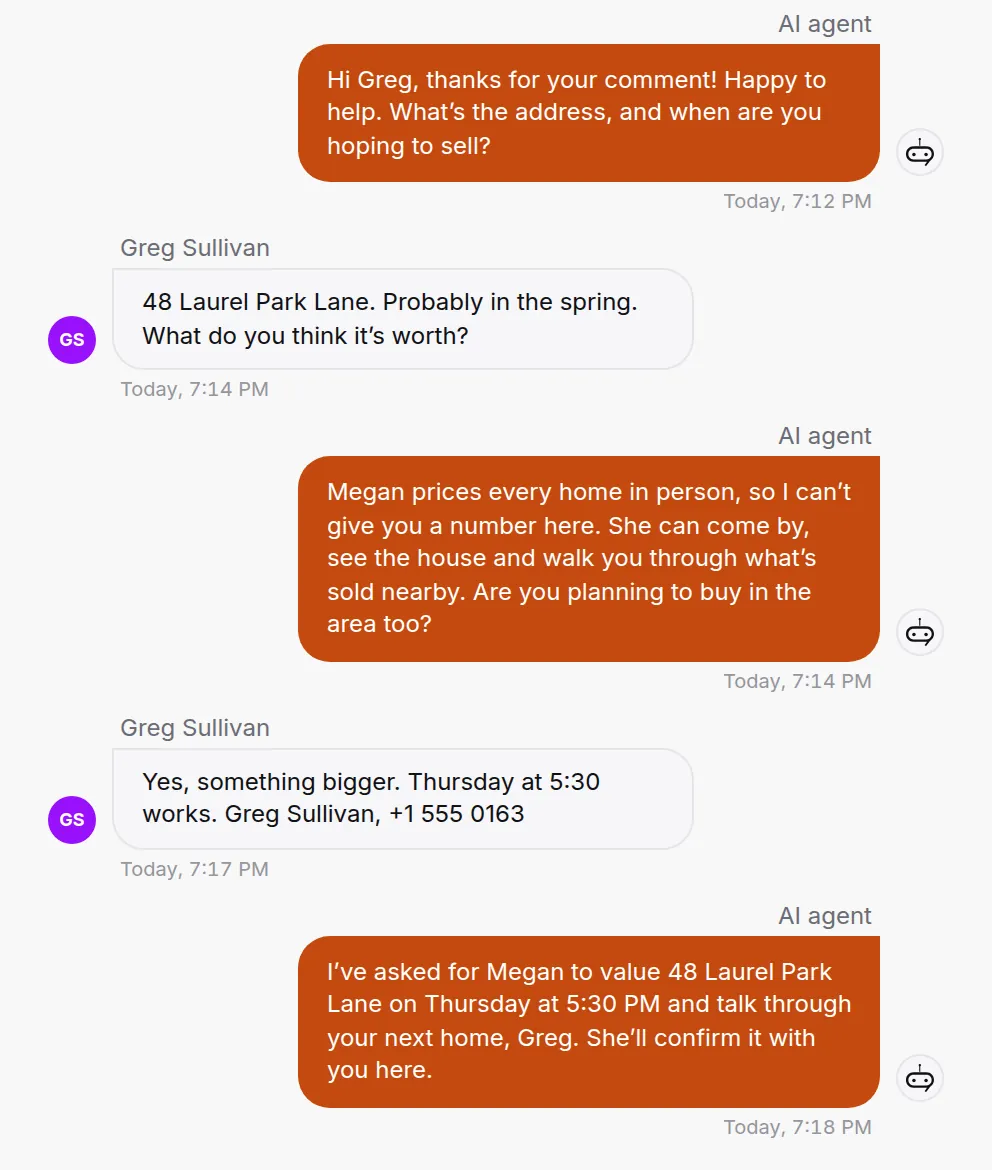
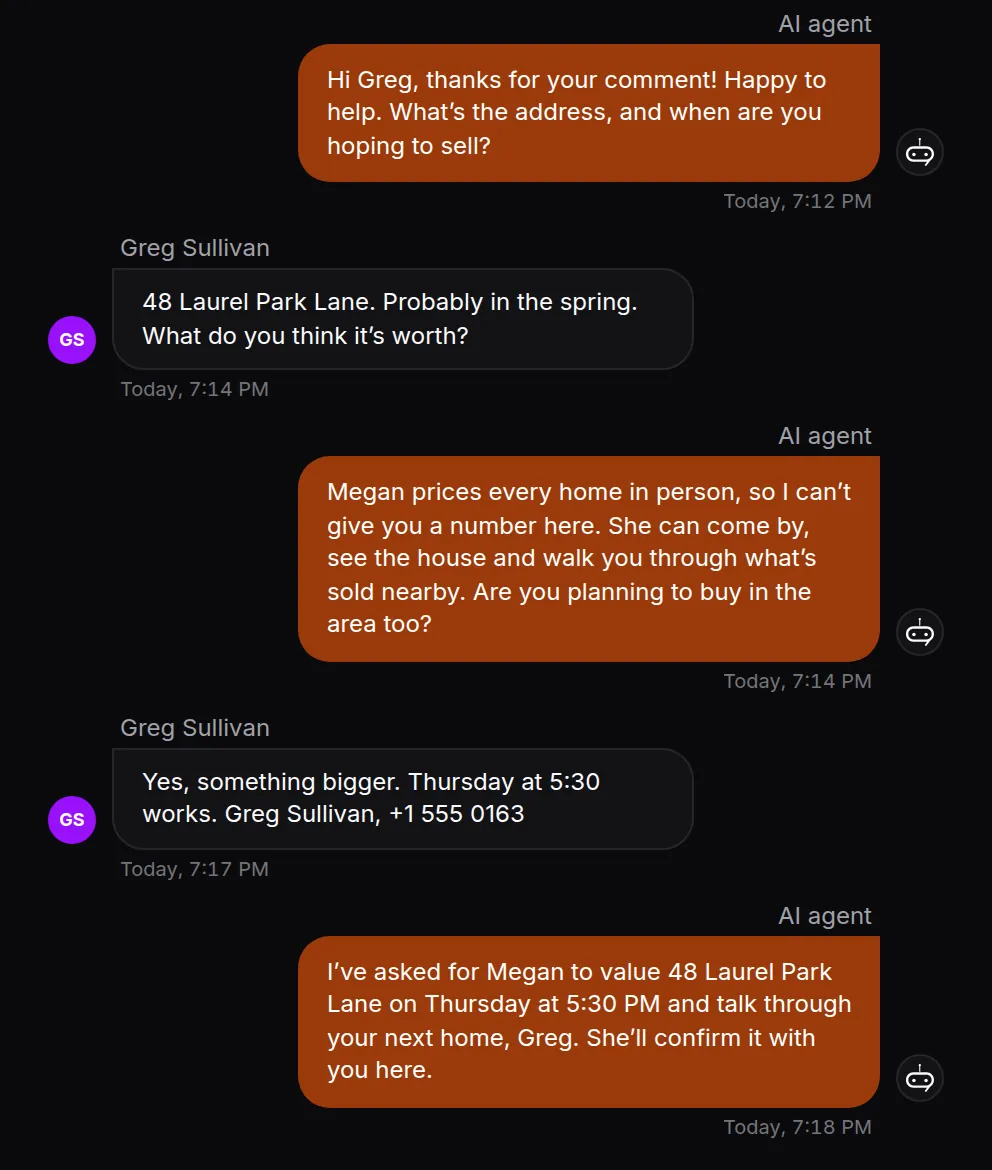
If your buyers already use WhatsApp, put your WhatsApp Business number on signs, listings and your social profiles. The same number then takes messages, photos and calls.
Open houses
An open house sign-in sheet is a list of warm leads that goes cold by Monday. Send each visitor a short message the same day: thanks, the detail they asked about, and an offer of a private showing.
Google Business Profile, farming, expireds and FSBOs
A Google Business Profile with reviews brings local sellers who search for an agent by area. Farming a neighborhood, calling expired listings and approaching for-sale-by-owner sellers are phone and door work. They sit outside chat, but every flyer and voicemail can carry a number or link people can message.
Seller and listing leads: how to get listings
Listing leads are sellers. You get listings from past clients and the people they refer, a home valuation offer on your website or Instagram, and expired and FSBO listings. A seller's first question is what the home is worth. Answer it with a listing appointment, where you give the price in person.
Speed to lead: why the first reply decides it
Speed to lead is the time between an inquiry and your first useful reply. The best-known study on it dates from 2007 and covered sales leads in general. Researchers from MIT and InsideSales.com looked at more than 15,000 web leads and 100,000 call attempts at six companies and found that “the odds of contacting a lead if called in 5 minutes versus 30 minutes drop 100 times” (Lead Response Management Study, 2007). They measured whether a lead was reached and qualified; the study did not track closings.
Real estate adds a second reason. Besides the repeat buyers who interviewed one agent, the same 2024 NAR survey found 81% of sellers contacted only one agent before choosing. We take these figures to mean that the first agent who answers well is often the only one a buyer or seller talks to. NAR does not draw that conclusion.
The hard part is timing. Many inquiries arrive in the evening and at weekends, while you are at a showing, at dinner or asleep. A reply at 8 the next morning is quick by office standards and slow for a buyer who was ready to book last night.
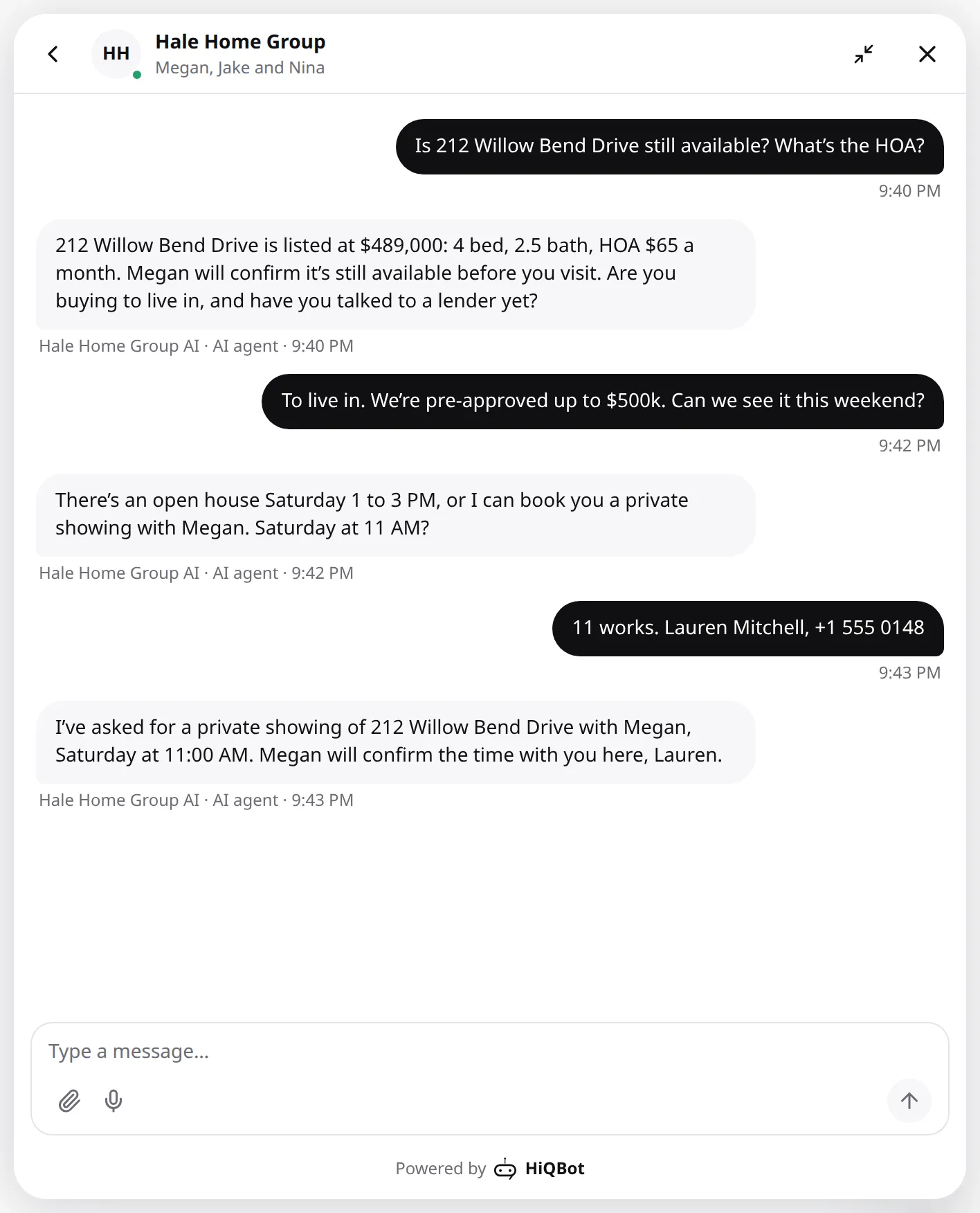
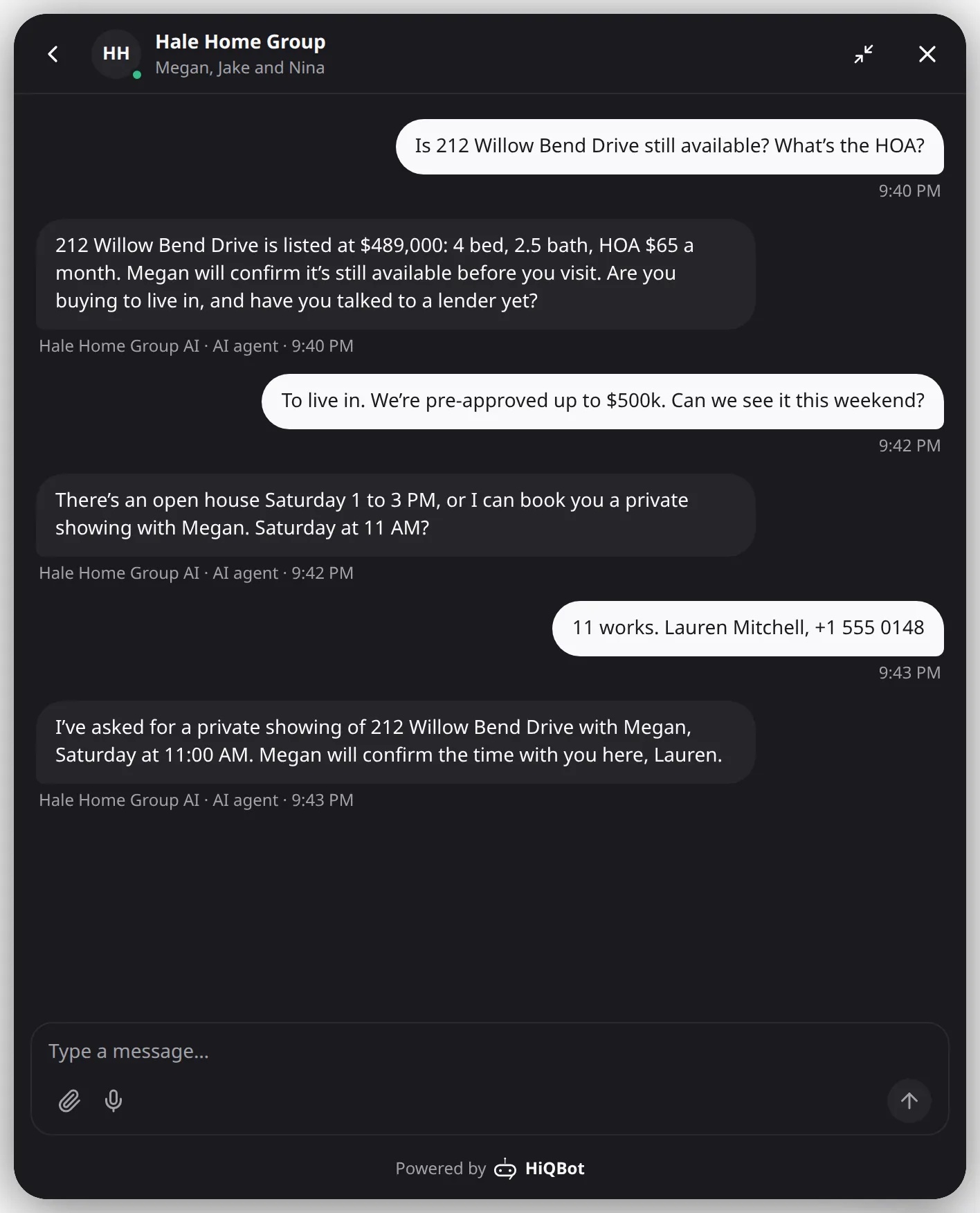
We ran this 9:40 PM inquiry in HiQBot with a sample team's listings. A buyer on a team's website asks whether 212 Willow Bend Drive is still available and what the HOA is. The AI agent answers from the team's listings, asks two questions and books a Saturday showing with Megan, one of the team's agents, three minutes later.
How to qualify a lead without leading with money
“What's your budget?” as the first question can put a buyer off before you have helped them. Ask about the home and their plans first, and let the lender question cover money. Ask every lead the same short set of questions:
- Are you buying, selling or renting?
- To live in, or as an investment?
- Which home, or which area?
- When are you hoping to move?
- Have you talked to a lender yet? For a buyer, this tells you where they stand on money without asking for a number.
- Are you working with another agent?
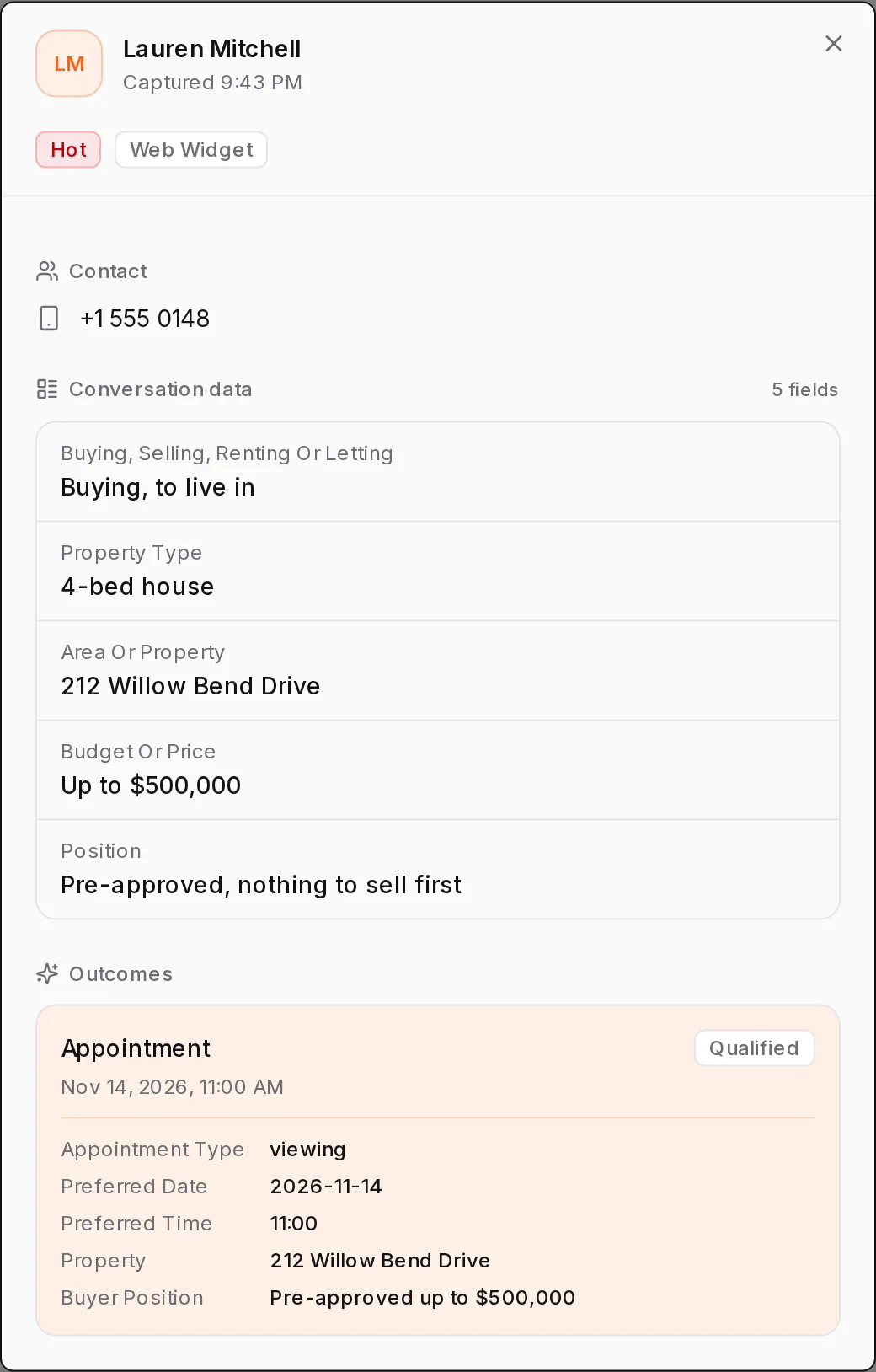
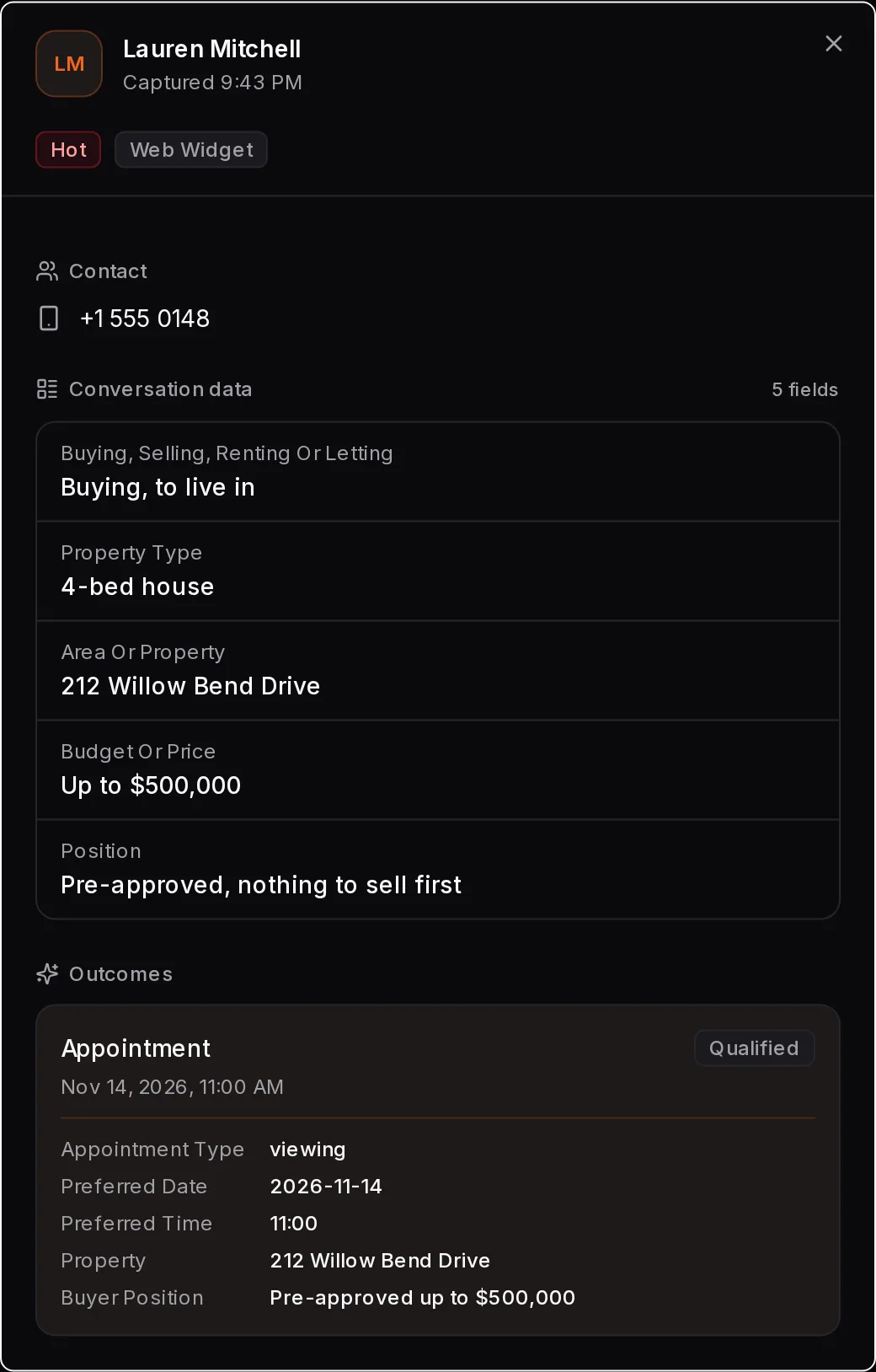
In the chat above, the AI answered the HOA question, then asked “Are you buying to live in, and have you talked to a lender yet?” The buyer answered both and added a budget: pre-approved up to $500,000. The lead card below is what the agent sees.
Keep the questions fair
A chat reply is a written statement, and the Fair Housing Act covers it. The Act bars any statement about the sale or rental of a home that indicates a preference, limitation or discrimination based on race, color, religion, sex, handicap, familial status or national origin (42 U.S.C. 3604(c)), and HUD's rule applies that to “all written or oral notices or statements” (24 CFR 100.75). In practice:
- Ask every lead the same questions.
- Never ask about or comment on race, religion, national origin, disability, children or family plans, or who lives in an area.
- Answer neighborhood and school questions with objective facts and where they come from. REALTOR Magazine, NAR's member magazine, tells agents to “only communicate objective information about neighborhoods”.
- Read what your chatbot says about neighborhoods before it goes live, and again after any change.
This is general guidance, not legal advice. HiQBot's AI never prices a home or calls one a good investment; when a seller asks what their home is worth, it books a listing appointment with you.
Follow-up that keeps leads from going quiet
A lead who booked nothing still needs a next step. A simple routine covers most of it:
- Confirm every showing in writing and remind the buyer the day before.
- Get an alert for each hot lead the moment it comes in, wherever you are.
- Mark each lead hot, warm or cold, so you call the hot ones first.
- For warm and cold leads, send new listings that match what they asked for. Ask before you add anyone to a broadcast list: on WhatsApp, Meta requires opt-in before a business messages someone first.
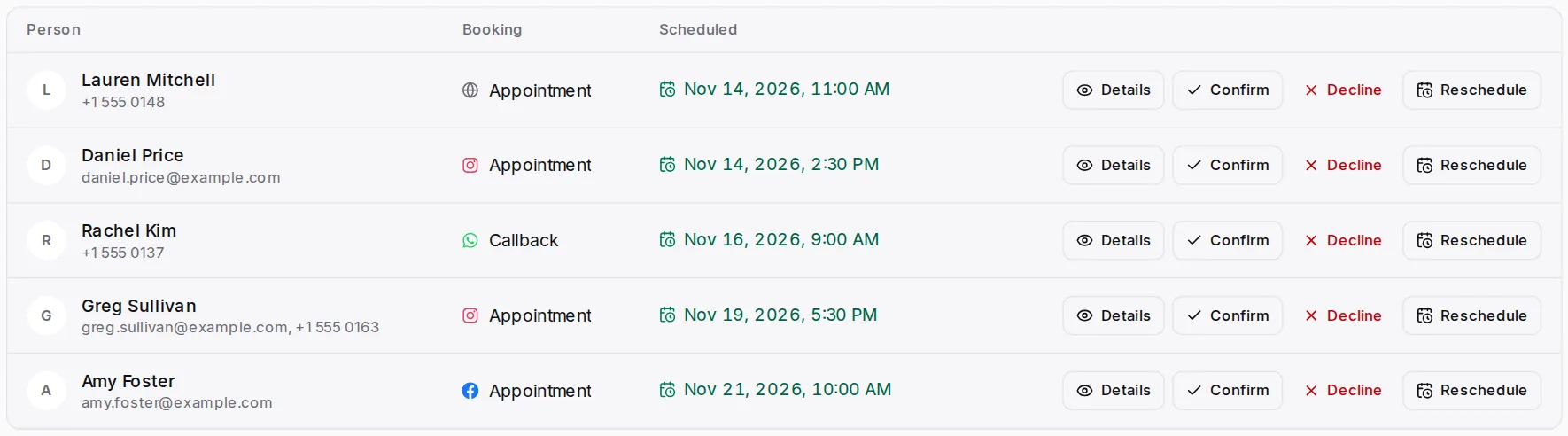
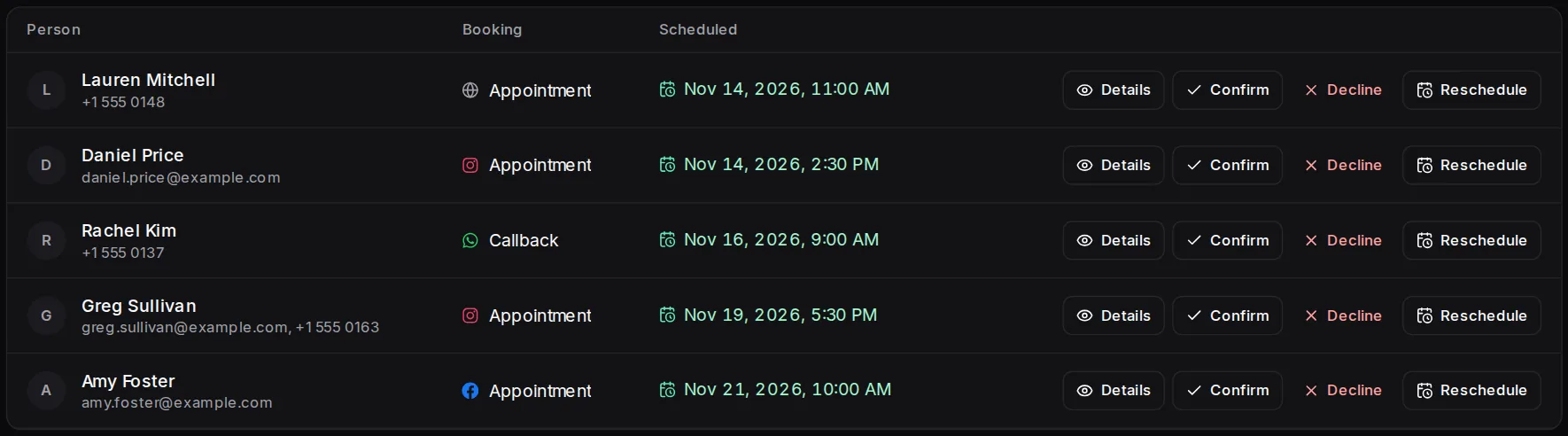
In HiQBot, bookings from every channel land in one list. You can switch on automations that confirm each booking in the chat and send a WhatsApp reminder before it, and your team gets a notification in HiQBot for each new lead.
Real estate lead generation software: what you need
You need four things, and they rarely come from one product:
- A website with your listings, often an IDX site.
- A CRM that keeps every lead and its history.
- Lead sources: referrals, portals, social media, ads.
- Something that answers new inquiries within minutes on every channel, day and night: you, an assistant, or a chat agent.
A real estate CRM covers the second. Some, such as Lofty, come with an IDX website too; others, such as Follow Up Boss, connect to the IDX website you already have. HiQBot covers the fourth. It keeps its own CRM and can send contacts and deals to HubSpot. It does not connect to the MLS, IDX feeds, Zillow, Realtor.com or real estate CRMs, and it does not send SMS. Your listings come in as a spreadsheet or a linked Google Sheet.
Real estate lead generation tools, by job
Most lists of lead generation tools for real estate agents mix these jobs together. Sorted by the job each does, the names agents compare most often look like this (checked 12 November 2026):
| Job | Tools agents compare | What you get |
|---|---|---|
| Paid buyer and seller leads | Zillow Premier Agent, Realtor.com | Inquiries from portal shoppers in the areas you pay for |
| IDX website, CRM and ads in one | BoldTrail (formerly kvCORE), Lofty, Real Geeks, CINC | A search site that captures registrations, with follow-up built in |
| Seller prospecting data | REDX, Vulcan7, PropStream | Expired, FSBO and likely-seller lists to call |
| CRM for leads from every source | Follow Up Boss | One record and follow-up plan per lead |
| First reply on chat and social | HiQBot | Answers, qualifying questions and booked showings on your website, Instagram and WhatsApp |
A solo agent rarely needs all five. Pick a lead source you can afford, a CRM to hold every lead, and a way to answer the inquiries that arrive while you are at a showing.
Where an AI chat agent fits, and where you do
AI for real estate lead generation helps most where speed matters and you are busy: the first reply. It helps least where judgment and trust matter, such as pricing a home, negotiating or advising a family. HiQBot splits the work into four parts that run alone or together:
- AI agent: answers from your listings, asks your questions, and books showings and listing appointments into Google Calendar inside the hours you set.
- Live chat: every conversation in one inbox. You take over any chat with its full history, from the inbox or by replying in the WhatsApp Business app on your phone.
- Guided flows: a tap-through menu on Instagram, WhatsApp, Messenger, Telegram and LINE (buy, sell, or talk to me), where any answer can go to the AI or to you.
- WhatsApp calling: a buyer who would rather talk calls your WhatsApp Business number and it rings you in the HiQBot inbox. The AI doesn't take calls.
For the full setup for a solo agent or small team, see our chatbot for realtors. For brokerages, letting agents and property managers, start with the real estate chatbot page.
A four-step setup
- Put your listings in a spreadsheet or Google Sheet: address, price, beds, baths, HOA and status.
- Connect your website chat, Instagram and WhatsApp.
- Connect Google Calendar and set your showing hours.
- Decide what happens when someone asks for you or the AI can't help: it hands you the chat, or takes their details so you can call back.
Common questions
How do you generate leads in real estate?
Pick two or three sources you can keep up, such as referrals from past clients, Instagram, open houses and your website. Then answer every inquiry within minutes, and count the showings and listing appointments each source brings.
Where do most realtors get their leads?
Most realtors get their leads from people who already know them. In NAR's 2024 Profile, 40% of buyers found their agent through a friend, neighbor or relative, and 66% of sellers used an agent who was referred to them or one they had worked with before. Portals, social media and open houses add more. Whatever the source, the biggest gain usually comes from answering every lead quickly.
How fast should a real estate agent respond to a new lead?
Within five minutes when you can. The MIT and InsideSales study found the odds of reaching a lead fell sharply between 5 and 30 minutes, and most buyers interview only one agent. After hours, a chat agent can answer and book a showing while you are away.
What is the cheapest real estate lead source?
Past clients and their referrals. They cost only your time. Instagram posts and open houses cost little beyond your time too.
How much does it cost to get real estate leads?
Referrals, Instagram and open houses cost your time. Paid lead companies charge in one of three ways: a monthly budget for a share of inquiries in a ZIP code, a price per lead, or a referral fee taken from your commission when the deal closes. Prices vary by market, so compare sources by what each closed deal costs you.
How can I generate real estate leads without paying for ads?
Five ways that cost only your time:
- Ask past clients for referrals.
- Post listings and “just sold” homes on Instagram with a word to comment.
- Message every open house visitor the same day.
- Collect Google reviews.
- Put chat on your listing pages.
What do real estate lead generation companies sell?
Real estate lead generation companies sell inquiries or data. Portals such as Zillow Premier Agent and Realtor.com sell buyer and seller inquiries in the areas you pay for, and services such as REDX and Vulcan7 sell expired, FSBO and likely-seller lists to call. HiQBot does not sell leads. It answers the ones you already get on your website, Instagram and WhatsApp.
Do real estate chatbots actually generate leads?
Yes, mostly from leads you already get. A chatbot turns more of those messages into showings and listing appointments. It answers at 9 PM on a Sunday while the buyer is still looking and books the showing before they message another agent. Finding new leads is still up to your listings and your marketing.
Does HiQBot connect to the MLS or my real estate CRM?
No. Leads stay in HiQBot's own CRM, and contacts and deals can go to HubSpot. Your listings come in from a spreadsheet or Google Sheet instead of an MLS or IDX feed.
How do you nurture cold real estate leads?
Send listings that match what they asked for, as often as they agreed to. Now and then, ask one easy question, such as whether their timing has changed. When one replies, answer the same day.
What is the 3-3-3 rule for real estate?
For agents, the 3-3-3 rule is a monthly habit: “call three people, send three handwritten notes and share three valuable resources each month” (Florida Realtors, September 2025). Some buyer guides use the same name for a savings rule.
Sources were read on 12 and 13 November 2026, and the screens are the real HiQBot product with sample data. How we write and check posts: editorial standards.