B2B lead generation: strategies, and how to turn inbound leads into booked meetings

Muhammad Hassan, FounderLinkedIn
Published Updated
B2B lead generation is how a business that sells to other businesses finds buyers who might need what it sells, and gets them into a conversation with sales. Most guides stop once the lead arrives. This one carries on to the reply and the booked meeting, because inbound leads are often lost in the hours after they write.
We make HiQBot, a customer service platform whose AI agent answers buyers on your website, WhatsApp and Instagram, qualifies them and books the demo or discovery call for your team to confirm. This guide covers the B2B lead generation strategies that bring buyers in, what the research says about replying to them, and how to turn inbound leads into meetings at any hour. The examples come from software, IT services and agencies, and the method works for any business that sells to businesses.
What is B2B lead generation?
B2B lead generation (often shortened to B2B lead gen) is the work of finding businesses that could buy from you and collecting enough about them to start a sales conversation: a name, a work email, the problem they want solved and when. It spans outbound work, where you reach out first, and inbound work, where the buyer comes to you through search, content, ads or a referral.
A lead becomes useful once it is qualified. Marketing teams often call an interested contact a marketing qualified lead (MQL), and one that sales has checked against fit, need and timing a sales qualified lead (SQL). In practice the step that matters is the meeting: a demo, a discovery call or a proposal request with a date on it.
B2B lead generation strategies
No single channel works for every business. Most B2B teams pick two or three from this list, measure which ones produce meetings, and put more time there.
Content and search
Guides, comparisons and pricing pages that answer what buyers search for. B2B buyers do much of their research alone: a Gartner sales survey published in March 2026 found that 67% of B2B buyers prefer a buying experience without a sales rep. Content brings them in, and the page they land on has to answer the next question too.
Founders and reps posting about the problems they solve, plus LinkedIn ads aimed by job title and company. A post rarely produces a lead on its own; it sends people to your site or your inbox, where the conversation starts.
Outbound email and calls
Short, researched messages to a list of companies that fit, followed up by phone. It works best with a narrow target and a reason to write now, such as a new hire, a funding round or a product launch.
Events and webinars
Trade shows, meetups and webinars give you named contacts who already showed interest. Follow up within a day, while they remember the conversation.
Referrals and partners
Customers who introduce you, and partners who sell next to you, such as agencies, consultants and software your product works with. Referred leads arrive warm and often skip the first qualifying steps.
Paid search and social ads
Ads on the terms buyers search, and ads on LinkedIn, Facebook and Instagram. They bring traffic the day you switch them on, and every click costs money, so the page or chat it lands on should answer and book.
Free trials, demos and website chat
The point where an interested visitor becomes a lead with a name. A trial button, a demo form and a chat that answers questions all sit here. This is the inbound half of B2B lead generation, and the rest of this guide is about getting it right.
Where B2B leads get lost
Most of the effort in B2B lead generation goes into getting the buyer to raise a hand. Then the hand goes up on a Friday evening, lands in a form inbox, and waits. In The Short Life of Online Sales Leads (Harvard Business Review, 2011), researchers sent a web lead to 2,241 US companies: 37% replied within an hour, and 23% never replied. Those that did reply within 30 days took 42 hours on average. Across 1.25 million leads, firms that tried to reach a lead within an hour were nearly seven times as likely to qualify it as firms that waited even one hour longer.
Inbound B2B leads usually stall in one of four places:
- The buyer has a question the website does not answer, such as an integration, a security point or pricing past a number of seats, and leaves.
- The form says “we'll be in touch”, and the reply comes the next working day.
- Sales books the call by email, and three messages go back and forth to find a time.
- Nobody asks the qualifying questions, so the rep walks into the first call cold.
Our speed to lead guide goes through the response-time research in detail and how to measure your own.
Turning inbound B2B sales leads into booked meetings
The fix is to answer, qualify and book in the first conversation, whenever it happens. Here is how that runs in HiQBot, using a sample software company called Relaypoint.
Answer the buyer's question from your own docs
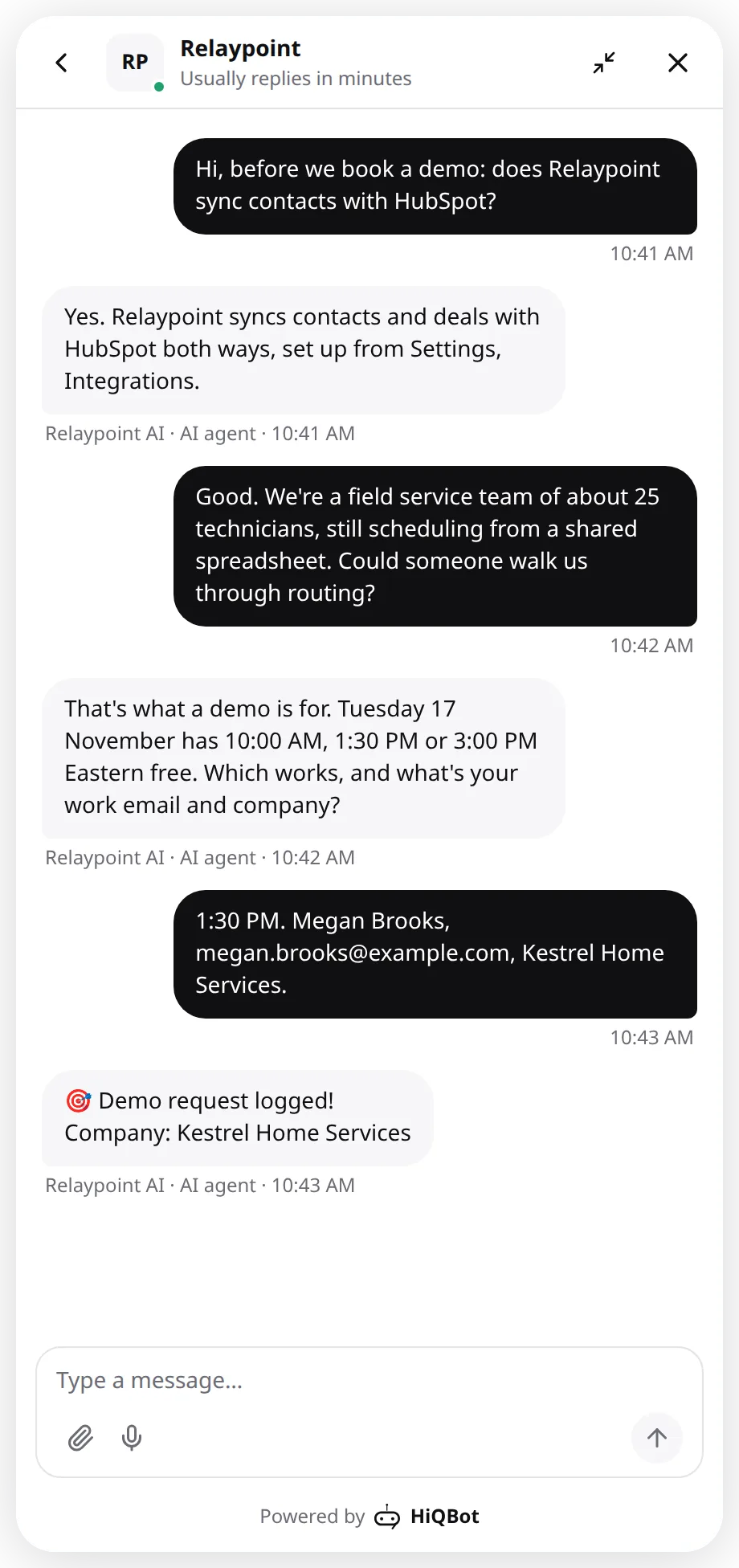
The AI agent answers on website chat, WhatsApp, Instagram, Messenger, Telegram and LINE within seconds, day or night. It answers from the help docs, setup guides, pricing notes and website pages you add, and when something is not written down it says so. Questions it could not answer go on a list with how often each was asked, so you know which page to write next.
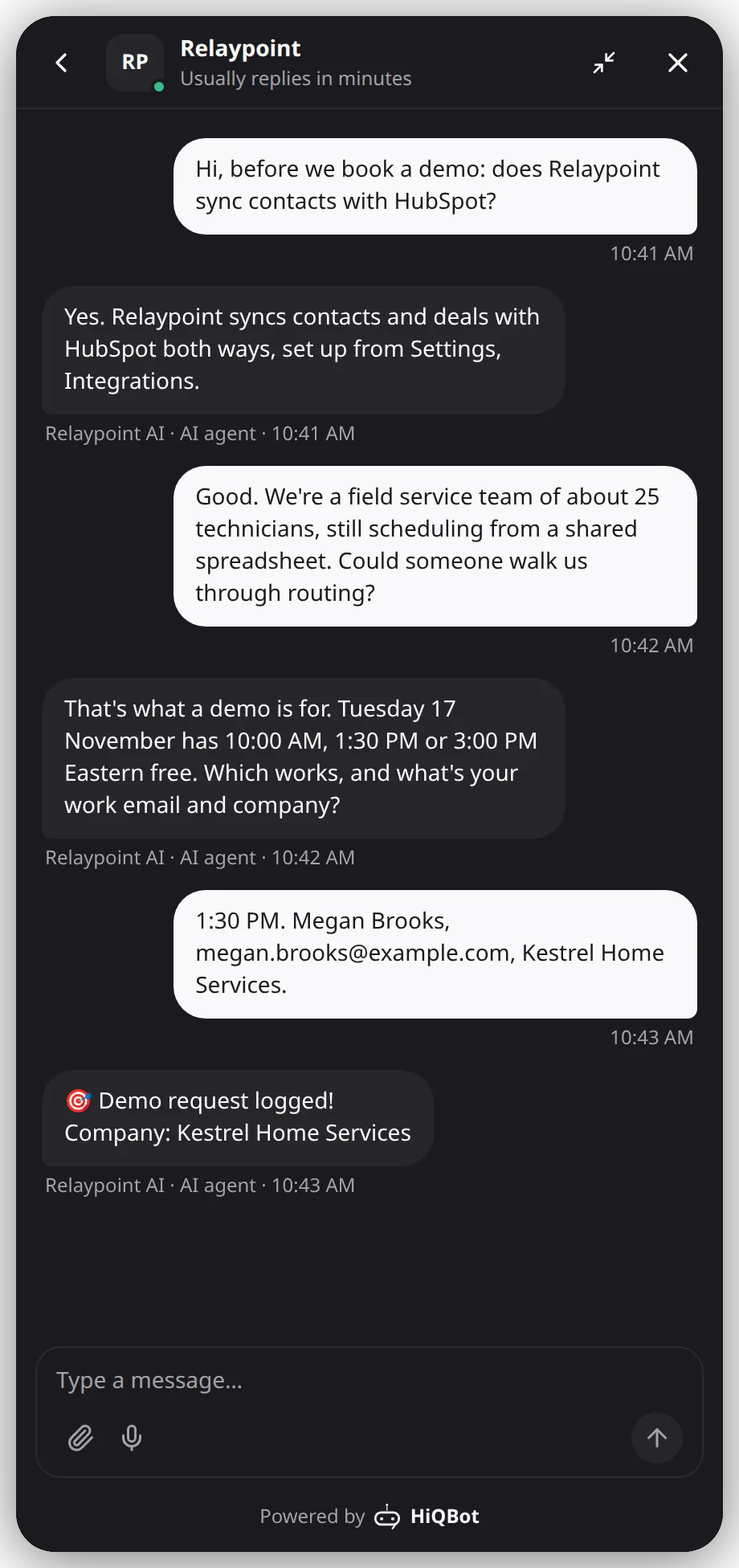
Below, a buyer asks whether the product syncs with HubSpot before booking a demo. The AI answers from Relaypoint's docs, offers three times on Tuesday and takes the work email and company.
Qualify the lead in the chat
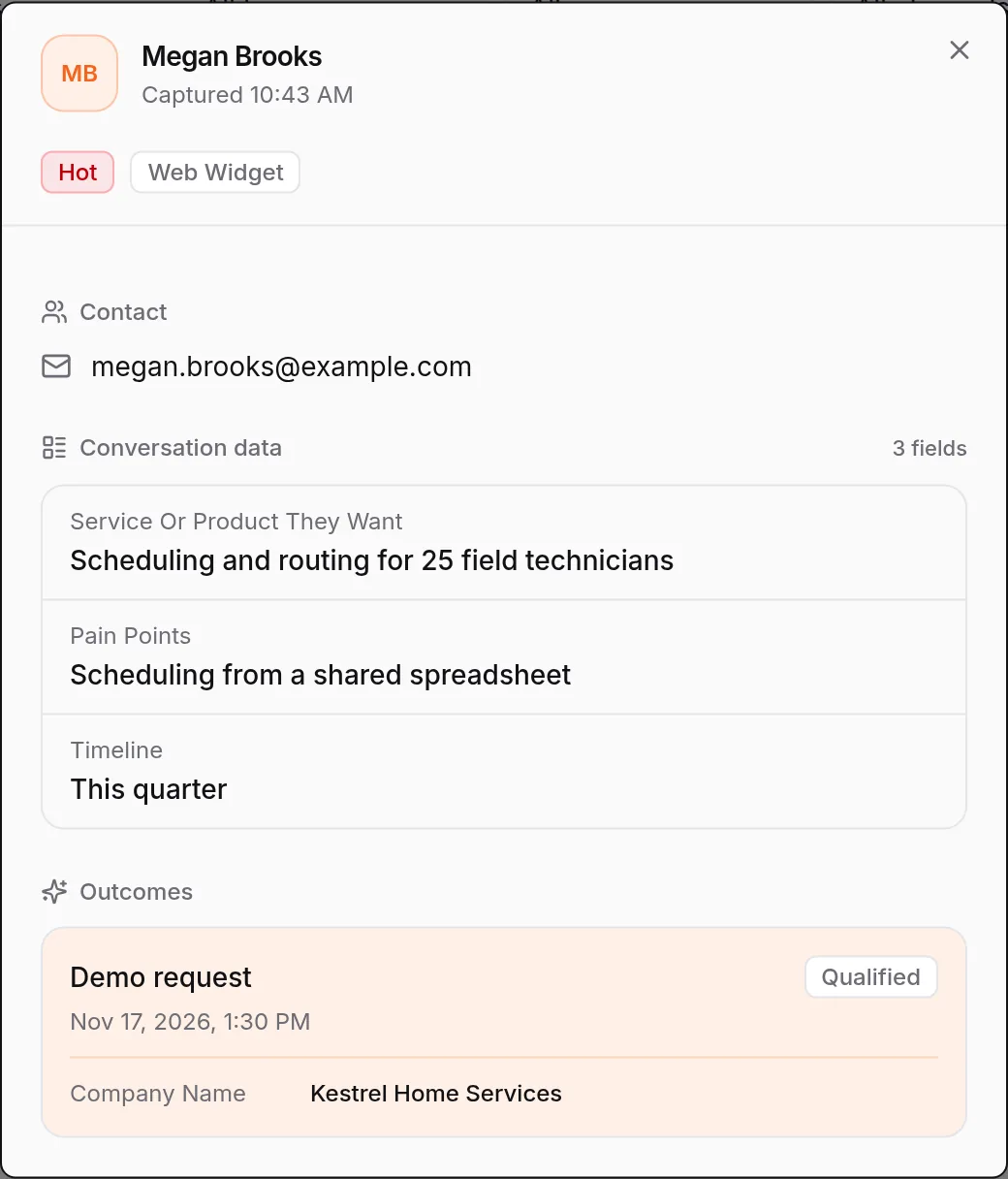
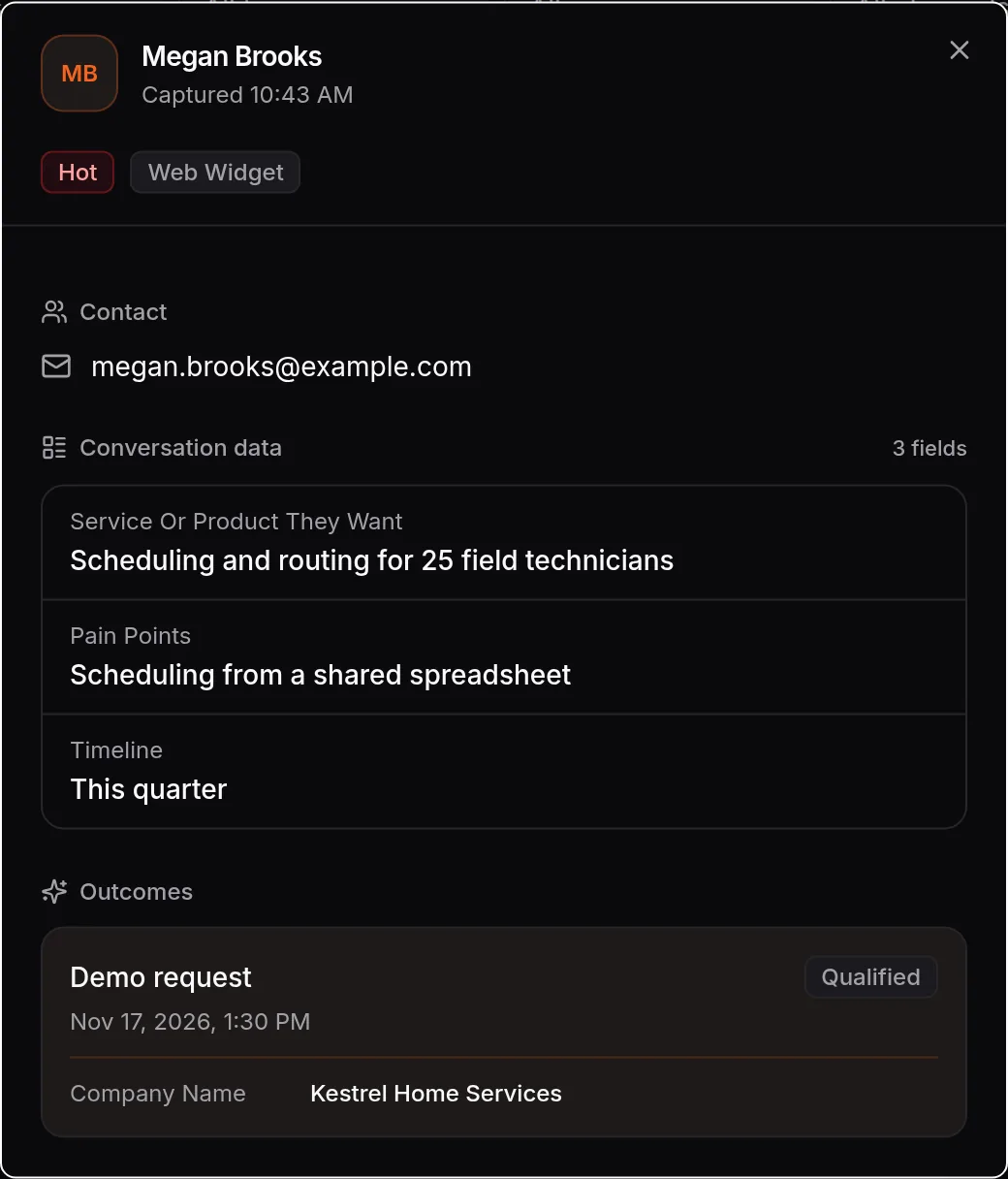
HiQBot's agent comes set up for software and technology companies, among other trades. It asks what the buyer wants to build or buy, what is not working today, their timeline, and a name and work email, then marks the lead hot, warm or cold. Your rep gets all of it on one lead card before the call. See how lead qualification works in HiQBot for the full set of questions and how leads are marked hot, warm or cold.
Book the demo or discovery call, any hour
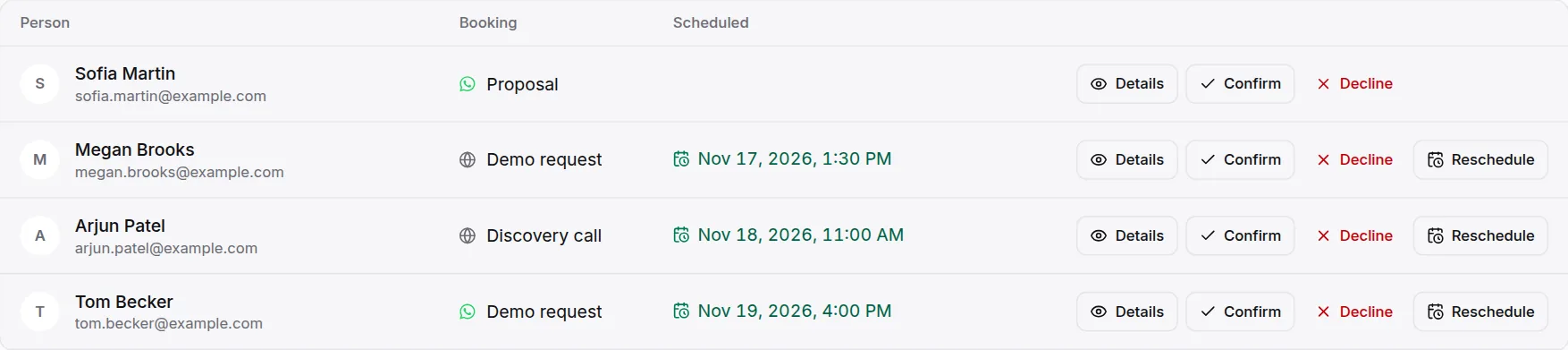
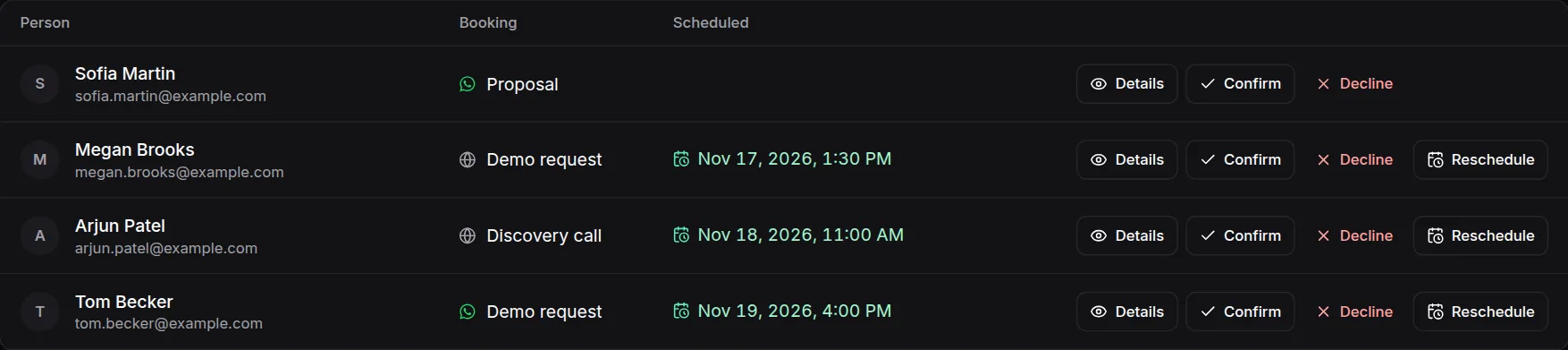
The agent offers free times from the hours your team runs demos and books a product demo with the date, time and company, a discovery call, or a proposal request for buyers who want it in writing. Every booking lands on one Bookings list, and your team approves each one from the dashboard with one tap. With Google Calendar connected, demos and calls land on the team's calendar, and a buyer can move or cancel in the chat. A confirmation and a reminder before the meeting can go out too.
Hand the conversation to a rep
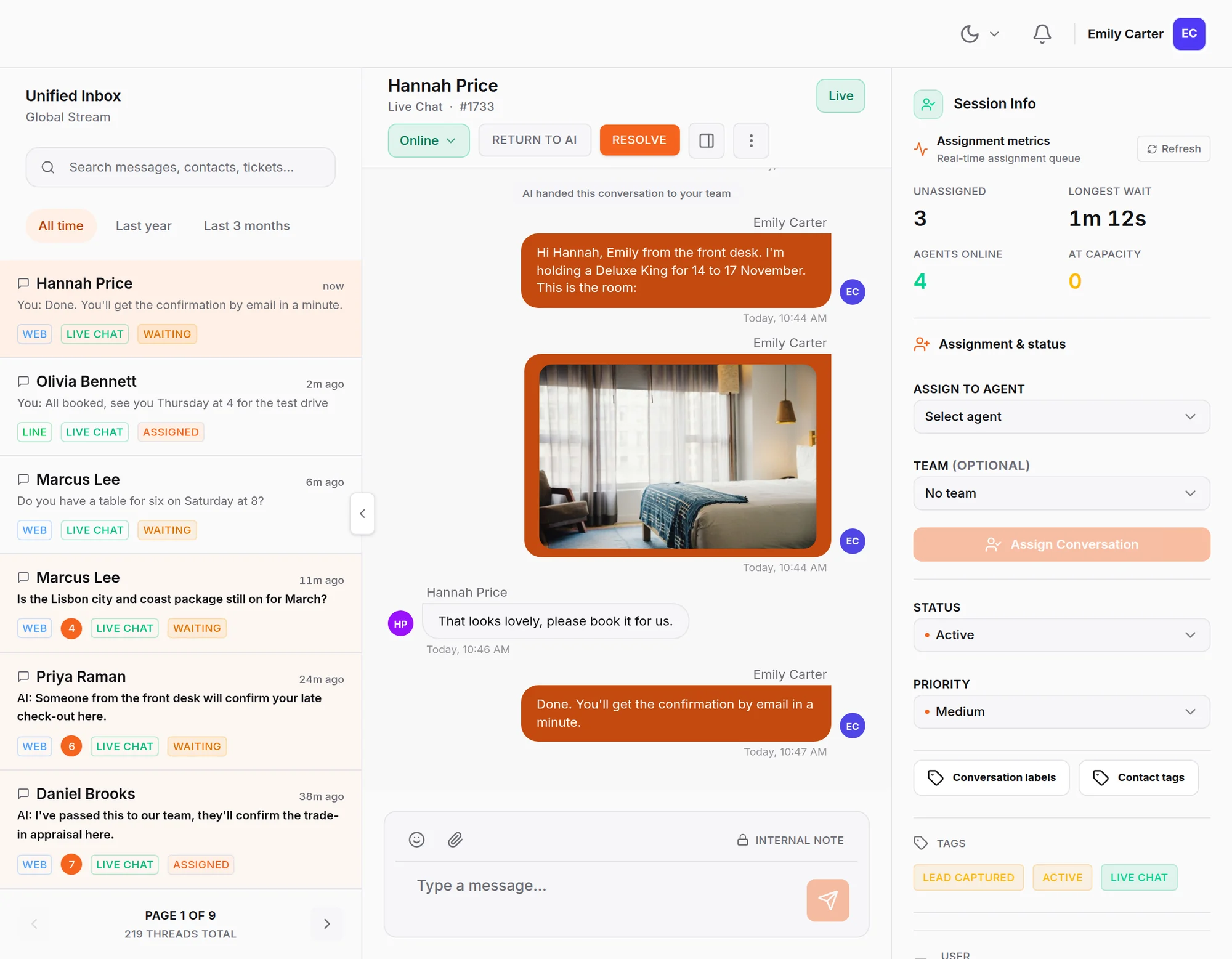
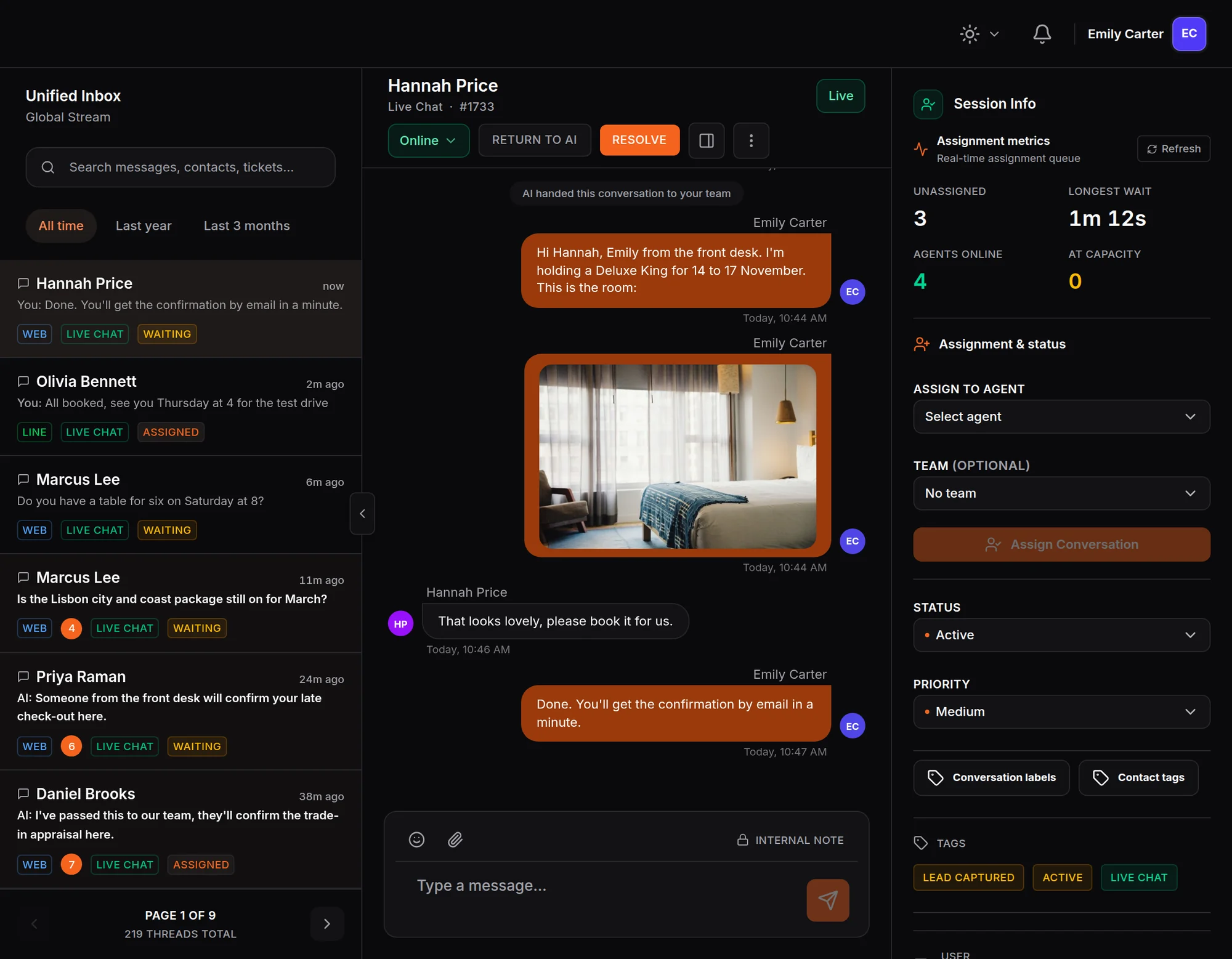
Some buyers want a person straight away. With live chat, every channel lands in one inbox, and a rep takes over the conversation with the whole chat and the lead details in front of them. They can leave a private note for a colleague or let the AI draft a reply. Buyers who prefer to talk can call your WhatsApp Business number, and it rings your team in the same inbox, beside the chat; the AI agent itself works in writing.
Send the lead to HubSpot
If your sales team works in HubSpot, connect it and leads become HubSpot contacts, with a deal when you want one. You choose which kinds of lead go across. Without HubSpot, every lead, conversation and booking stays in HiQBot's own contact list.
Make ads and LinkedIn traffic land in a conversation
Paid clicks cost the most, so they deserve the fastest answer. Click-to-WhatsApp and Instagram Direct ads open a chat the agent answers at once, and a campaign landing page with the website chat on it gets the same treatment as your pricing page. On WhatsApp, Telegram and LINE, a guided flow can greet a new chat with buttons such as Book a demo, Ask a question and Talk to the team.
The same setup works outside software. An IT services firm can book a discovery call about a migration, and an agency can take a proposal request with the brief. See the SaaS chatbot page for the software setup, or HiQBot solutions by industry for clinics, dealers, hotels and online stores.
Tools that turn inbound B2B leads into meetings
These tools work on the inbound half: they answer the visitor, qualify them and book a meeting with sales. We put HiQBot first because it is our product and our pick for teams who want leads booked on chat apps as well as the website. The other tools' facts were read on their own websites on 13 November 2026; prices change, so check before you buy.
| Tool | What it does with an inbound lead | Channels | Published price | Trial or free plan |
|---|---|---|---|---|
| HiQBot (our pick) | The AI agent answers from your docs, qualifies the buyer and books the demo or discovery call for your team to confirm; a rep takes over in one inbox | Website chat, WhatsApp, Instagram, Messenger, Telegram, LINE | From $49 a month for 2,500 message credits, US-dollar list price; local currency and tax show at checkout (pricing) | 7-day trial |
| Chili Piper | Books meetings from demo forms; Chat AI answers, qualifies and books | Website forms and chat | Growth $1,250 a month with 15 seats, billed annually | None listed |
| Qualified | Piper AI SDR talks to website visitors and turns visits into meetings | Website, email | On request | None listed |
| HubSpot | Free booking links; Breeze customer agent answers and can qualify a lead | Chat, email, forms, WhatsApp, Messenger | Agent $0.50 per resolution, needs Professional (Sales Hub from $90 per seat a month) | Free plan with one meetings link |
| Intercom | Fin answers support questions; booking not listed on the pricing page | Chat, email, in-app; WhatsApp and phone pay as you go | Fin from $0.99 per outcome plus seats from $29 a month | 14 days |
HiQBot
Fits any business that sells to businesses and wants the meeting booked in the first conversation, on the website or on WhatsApp and Instagram. The agent comes set up for software and technology companies, asks the qualifying questions, and puts demos, discovery calls and proposal requests on one Bookings list your team confirms. It connects to HubSpot and Google Calendar.
Chili Piper
Built around the demo form: its site says it can “turn form fills into booked meetings before buyers leave the page”, and its Chat AI, on the Scale plan from $3,500 a month, answers questions, qualifies and books meetings around the clock. Plans are billed annually and start at $1,250 a month with 15 seats. We found no free trial on the pricing page.
Qualified
Piper, its AI SDR, holds conversations with buyers on your website and by email, and Qualified says it can turn “any website visit into a real-time sales meeting.” All three plans are priced on request.
HubSpot
The free Meetings tool gives each rep a booking link that syncs with Google and Office 365 calendars (one personal link on the free plan). Breeze customer agent answers and can qualify a lead on chat, email, WhatsApp and Messenger, but needs a Professional or Enterprise edition and costs $0.50 per resolution in HubSpot credits. Sales Hub Professional starts at $90 per seat a month plus a $1,500 onboarding fee.
Intercom
Fin answers customer questions on chat, email and phone, priced from $0.99 per outcome on top of seats from $29 a month. Lead qualification and meeting booking are not listed on its pricing page. There is a 14-day free trial.
Drift, once a common choice here, is being retired: Salesloft announced the gradual sunset of Drift on 5 March 2026 and refers its customers to 1mind.
B2B demand generation vs lead generation
B2B demand generation (demand gen) builds awareness of the problem you solve among buyers who are not looking yet: podcasts, ungated guides, research, events and brand ads, usually without asking for an email. Lead generation captures the buyers who are ready, as named contacts sales can follow up.
The two depend on each other. Demand generation is why someone searches for you six months later; lead generation is the form, the chat or the call that turns that visit into a meeting. Judge demand generation by direct and branded traffic and the pipeline that follows, and lead generation by meetings booked.
What to measure
Booked meetings are the number that pays. Five figures tell you whether B2B lead generation is working:
- Leads by channel, so you know where to spend.
- Median time to the first useful reply, by channel and by hour, with unanswered leads counted on their own.
- Share of leads that book a demo, a discovery call or a proposal.
- Share of booked meetings that happen, and the share that become an opportunity.
- Cost per booked meeting, for each paid channel.
Read them by week. When a channel brings many leads and few meetings, look first at how fast those leads got a reply and whether anyone asked the qualifying questions.
A B2B lead generation checklist
- Write down who buys from you: industry, role, the problem, the trigger that makes them look.
- Pick two or three channels those buyers use, and give each a weekly routine.
- Make every page that brings traffic answer the questions buyers ask before they book.
- Answer every inbound lead in minutes, including evenings and weekends.
- Ask the same qualifying questions each time: need, current problem, timeline, work email.
- End each qualified conversation with a demo, a discovery call or a proposal request with a date.
- Hand hot leads to a rep with the conversation and answers attached.
- Track meetings booked per channel each week, and move budget toward what books.
Common questions
What is B2B lead generation?
B2B lead generation is finding businesses that may buy from you and starting a sales conversation with them. It covers outbound work such as email and calls, and inbound work such as content, search, ads and referrals, and it ends when a qualified buyer books a meeting.
What are the best B2B lead generation strategies?
The best strategies are the ones your buyers already respond to. For most B2B companies that means content and search, LinkedIn, referrals and partners, and targeted outbound, with a fast reply and a booked meeting at the end of each.
What is the difference between lead generation and demand generation?
Demand generation builds awareness and interest in the problem you solve, often without asking for contact details. Lead generation turns that interest into named contacts that sales can follow up.
How do you qualify a B2B lead?
Ask what they need, what is not working today, when they want to start and who they are, with a work email. Then mark the lead hot, warm or cold so sales calls the hot ones first. An AI agent can ask these questions in the first chat.
How fast should you respond to a B2B lead?
Within five minutes for a web form and within seconds in a chat. Research on web leads found the odds of qualifying a lead fall sharply after the first hour.
Can AI generate B2B leads?
AI can capture and qualify the leads your marketing brings in. HiQBot's AI agent answers buyers on your website and messaging channels, asks the qualifying questions and books the demo or discovery call for your team to confirm. It does not send cold outreach.
Does HiQBot work with HubSpot?
Yes. Connect HubSpot and leads from the chat become HubSpot contacts, with a deal if you want one. You choose which kinds of lead are sent.
Sources were read on 13 November 2026, and the screens are the real HiQBot product with sample data. How we write and check posts: editorial standards.